ECONOMIC GROWTH, INFLATION, & the BOND MARKET
Executive Summary & Recommendation
Why does a report on the US bond market matter to a diversified portfolio? Because US Treasury yields form the closest thing global markets have to a common risk-free benchmark. In practical terms, the required return on equities, credit, property, infrastructure and private assets begins with that risk-free rate and then adds compensation for risk. When Treasury yields rise, discount rates rise and the present value of future cash flows falls; when yields decline, the valuation pressure works in reverse. The bond outlook is therefore an asset-allocation question, not merely a fixed-income question.
The macro backdrop is late-cycle but not recessionary. US growth has remained resilient, helped materially by AI-related capital expenditure, while the labour market has moved into a much cooler ‘low hiring, low firing’ equilibrium. The latest payroll and JOLTS evidence suggests employment is no longer a meaningful source of inflation pressure. Inflation nevertheless remains above the Federal Reserve’s objective and the energy shock has created a near-term asymmetric policy risk: a small number of hot inflation readings could revive tightening concerns, while modestly weaker growth may not immediately trigger easing.
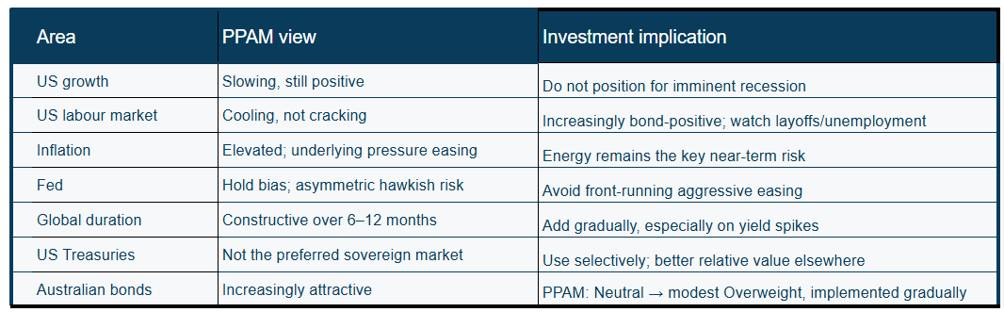
PPAM Recommendation: Move gradually toward an above-benchmark Government Bond position over a 6–12 month horizon, but do not chase the trade aggressively while energy and geopolitical risks remain elevated. We prefer relative-value opportunities in non-US developed sovereigns — particularly Australian, UK, German and Canadian government bonds — over concentrating duration in US Treasuries. For Australian portfolios, our view is to move ACGBs from Neutral to a modest Overweight gradually. Maintain a modest inflation-linked allocation as a hedge against a renewed energy-driven inflation surprise.
Four Charts That Matter
These four indicators capture the transmission mechanism behind the recommendation: labour-market momentum, the energy shock, the market’s rates repricing and the way global bond pricing transmits into Australia.
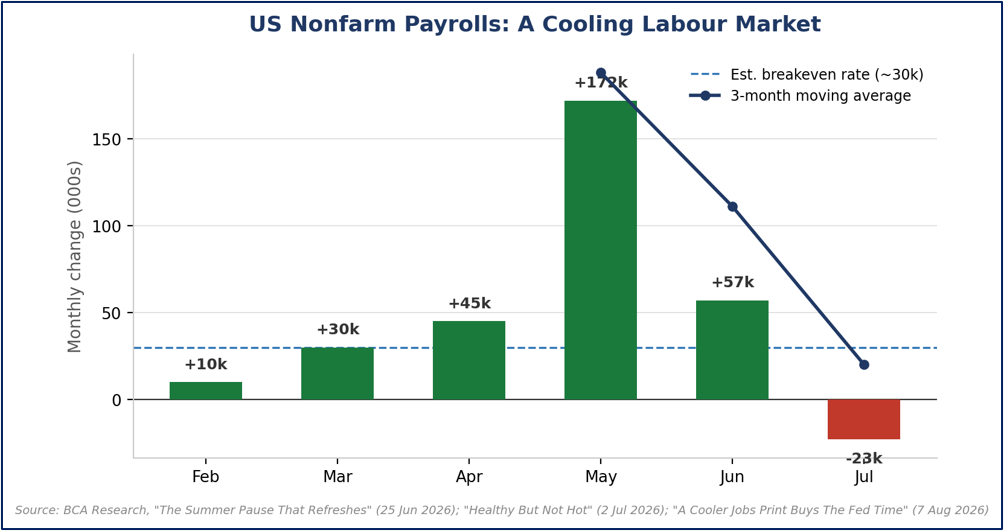
Chart 1 — US payrolls: the three-month moving average has fallen toward the estimated breakeven pace, signalling a much cooler labour market.
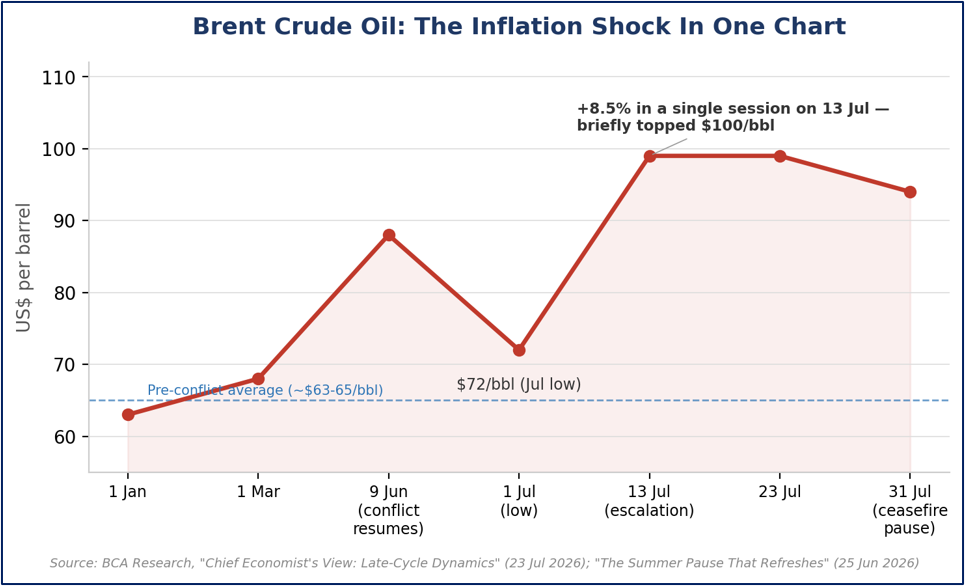
Chart 2 — Brent crude: the energy shock is the proximate source of the current inflation risk and the principal near-term challenge to the duration thesis.
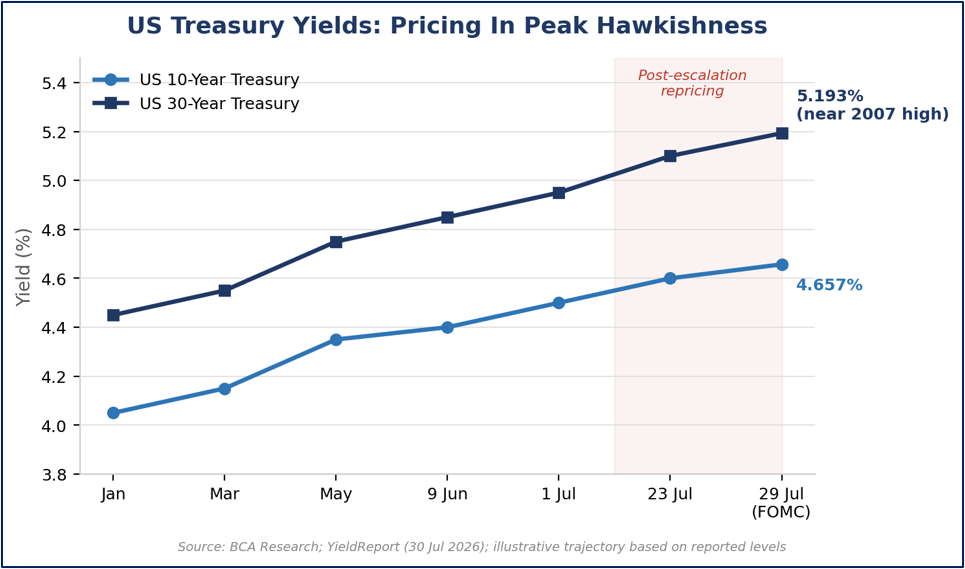
Chart 3 — US Treasury yields: markets have repriced materially more hawkishly as inflation and geopolitical risks increased.
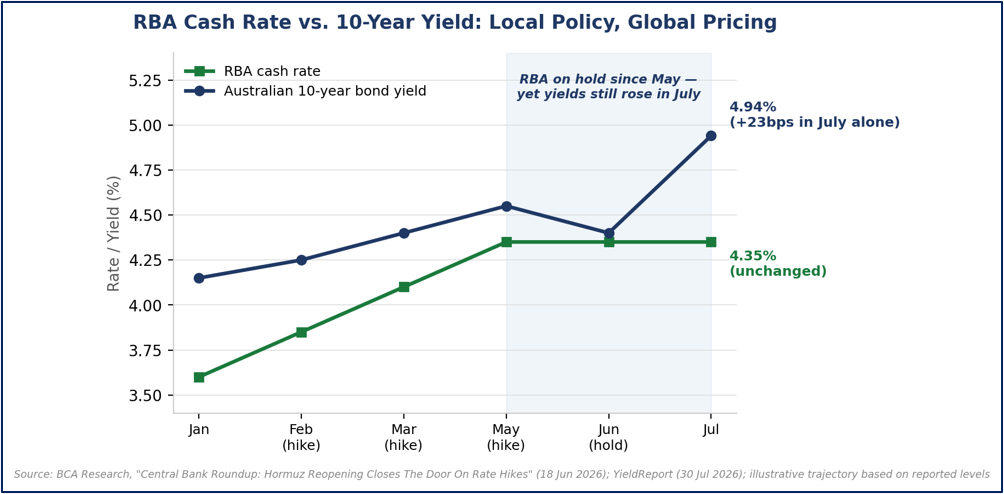
Chart 4 — Australia: the cash rate can be unchanged while long yields rise, illustrating the transmission of global risk-free pricing into domestic markets.
1. Economic Growth — Resilient, but Narrower
The defining feature of the current US cycle is the unusual importance of capital expenditure. AI-related investment has helped offset softer household spending momentum and is one of the strongest reasons not to position for an imminent recession. We believe recession remains unlikely during 2026, although downside risks rise later as the cycle matures.
Reasons to remain constructive
- AI-related investment is supported by a secular rise in compute demand and large hyperscaler backlogs, making the capex cycle more durable than a purely cyclical investment upswing.
- US growth forecasts have been comparatively resilient, and consumer spending has continued to receive support from employment and household wealth.
- The labour market remains ‘low hiring, low firing’: hiring is weak, but layoffs have not yet moved to levels normally associated with recession.
Reasons for caution
- Payroll momentum has deteriorated sharply: the cited sequence moves from +172,000 in May to +57,000 in June and -23,000 in July, with a three-month average near breakeven.
- The decline in unemployment has been flattered by weaker participation rather than strong hiring, while wage growth has cooled.
- The economy has become more dependent on AI capex. A slowdown in that investment cycle could weaken both capital spending and the equity-wealth channel supporting consumption.
- Persistent energy disruption would act as a tax on households and businesses and could eventually force demand destruction.
PPAM Assessment: Growth is slowing rather than collapsing. That argues against an aggressive recession trade today, but the narrowing of growth leadership and weakening labour momentum increase the probability that increasing exposure to Bonds becomes more attractive as 2026 progresses.
2. Labour Market — The Most Important New Evidence
The labour market is the clearest real-time bridge between the growth, inflation and bond-market arguments. Our view is that conditions are resilient but increasingly balanced: June JOLTS openings fell to 7.359 million, the openings rate eased, quits remained subdued and the layoff rate stayed near 1.1%. The ‘low hiring, low firing’ environment is important because it distinguishes a cooling labour market from one that is already cracking.
The payroll trajectory adds a more cautious signal. May’s strength did not persist: June slowed materially and July contracted, while prior months were revised lower. Wage growth also cooled. We believe the labour market is no longer contributing meaningfully to inflation. One indicator we monitor closely is BCA Research’s Dual Mandate Surprise Index, which combines labour-market and inflation surprises and has historically provided a useful lead on the next direction for Treasury yields. The recent rollover in the index reinforces our view that peak Fed hawkishness is likely behind us, provided commodity prices continue to normalise.
Investment Interpretation: A move from low hiring/low firing to rising layoffs and unemployment would be the decisive signal to increase duration more aggressively. Conversely, a renewed rise in vacancies, quits and stronger wages growth would weaken the bond case.
3. Inflation — Improving Underneath, Still the Constraint
Inflation remains the main obstacle to a rapid fall in bond yields. The source reports place headline and core PCE materially above the Fed’s 2% objective, while the energy shock has raised near-term headline risk. The critical distinction is between a temporary commodity shock and a broad, self-reinforcing inflation process.
Why inflation could remain problematic
- Energy prices remain vulnerable to geopolitical disruption, and a renewed oil spike could produce additional headline inflation and pressure central banks to remain restrictive.
- Tariffs, reshoring (returning manufacturing to the domestic economy), commodity scarcity and higher investment requirements point to a structurally less disinflationary backdrop than prevailed before the pandemic.
- Large fiscal deficits and supply-side constraints can keep real and nominal yields elevated even if cyclical inflation improves.
Why the pressure may fade
- Labour-market slack has increased and wage growth has slowed, reducing the risk of a wage-price spiral.
- Long-term inflation expectations remain reasonably anchored, indicating that central-bank credibility has not broken.
- If oil normalises, the Fed’s inflation problem becomes progressively easier because the underlying labour-market contribution to inflation is already weaker.
PPAM Assessment: The base case is that the energy-driven overshoot fades rather than becomes entrenched, but this is the principal risk to our current Bond recommendation. The appropriate response is gradual implementation and a modest inflation-linked hedge, not abandoning duration altogether.
4. Federal Reserve — An Asymmetric Setup
The Fed faces an asymmetric policy problem. A small number of unexpectedly hot inflation readings could quickly revive tightening expectations, whereas modestly weaker growth may not be sufficient to trigger aggressive easing while inflation remains above target. For bonds, this means near-term upside risk to yields can persist even as the medium-term growth case becomes more supportive.
This asymmetry is why we are distinguishing between the strategic direction of the trade and its tactical implementation: the strategic bias is toward more duration; the tactical approach is to add on weakness rather than assume yields must fall immediately.
5. Bond Market — Opportunity Building, Entry Point Matters
The recent rise in long-term yields reflects a combination of inflation concern, geopolitical uncertainty, still-positive growth and a structurally higher term premium. Our central case is that the 10-year Treasury yield is unlikely to sustainably break materially above 5%, although yields may remain broadly rangebound through much of 2026 while recession risk stays low.
The case for increasing Bond Exposure.
- Cooling employment, moderating wages and eventual Fed easing would support long-duration government bonds.
- Much of the recent backup in yields has reflected real rates rather than a permanent rise in inflation expectations; if the energy shock fades, that repricing can reverse.
- If the energy shock instead forces additional tightening, the resulting drag on growth can itself become bullish for duration over a 6–12 month horizon.
- Duration also restores portfolio protection against a material equity-market drawdown as the cycle matures.
Why not go aggressively overweight today?
- Inflation is still above target and oil remains a live upside risk.
- US fiscal deficits, Treasury supply and a higher term premium can limit the decline in long yields even in a slowdown.
- Growth has not collapsed and layoffs remain contained, so the market may not yet price a conventional easing cycle.
- Relative valuations favour selected UK, German and Canadian government bonds over US Treasuries, reinforcing the case for diversifying sovereign duration rather than concentrating it in the US.
6. Australian Bonds — Global Pricing, Better Local Direction
Australian bonds are heavily influenced by the global risk-free curve. The RBA cash rate remained unchanged while the Australian 10-year yield rose, demonstrating that domestic bond pricing cannot be understood solely through RBA policy response.
Our view is that the RBA tightening cycle is probably complete despite recent hawkish rhetoric. Softer trimmed-mean inflation, easing price pressure and a gradually softer labour market make the direction of travel more bond-friendly. ACGBs are not unequivocally cheap, but the balance of risks is becoming more supportive of adding to exposure.
PPAM Recommendation: We recommend moving Australian government bonds from Neutral to a modest Overweight, implemented gradually. The rationale is attractive real yields, a likely end to the domestic tightening cycle and diversification away from the more crowded US Treasury market. We would add exposure progressively rather than all at once while global rate volatility remains elevated.
7. Three Indicators That Should Determine the Next Move
The recommendation should be treated as a process rather than a one-off forecast. These three indicators provide a simple monitoring framework for deciding whether to add further duration or pull back.

8. Asset-Allocation Consequences
The Bond call matters beyond just fixed income because the risk-free curve is the discount-rate foundation for all assets in the portfolio.
Equities. Persistently high real yields penalise expensive long-duration growth equities most heavily. Maintain valuation discipline and avoid excessive dependence on US mega-cap growth; falling yields would become a broader valuation tailwind.
Credit. Spreads offer limited protection if growth deteriorates materially. Prefer higher-quality investment-grade and senior exposures over lower-quality credit while late-cycle risks rise.
Property and infrastructure. Higher government yields raise discount and capitalisation rates. Favour assets with resilient, contracted or inflation-linked cash flows and manageable leverage.
Gold. Retains value as a diversifier, particularly against geopolitical and policy uncertainty, although real yields and Fed credibility remain important short-run drivers.
Cash. Remains tactically useful while yields are elevated and the duration entry point is uncertain, but becomes less attractive once a genuine easing cycle is established.
9. Final Recommendation
Our central scenario is a transition from a high-yield, late-cycle environment toward a more favourable duration environment as growth slows. The US economy is not yet signalling recession, but labour-market momentum has weakened sufficiently to reduce inflation pressure and increase the probability that peak policy hawkishness is behind us if energy prices normalise.
That leads to a deliberately staged recommendation. First, begin moving above benchmark duration in high-quality sovereign bonds over the next 6–12 months, using yield spikes to build exposure rather than chasing rallies. Second, diversify that duration away from an exclusive US Treasury expression: we see better relative value in selected UK, German, Canadian and Australian government bonds. Third, retain a modest inflation-linked allocation as insurance against renewed energy-driven inflation.
The thesis is conditional, not static. Rising layoffs, unemployment and falling underlying inflation would justify increasing duration more decisively. A renewed acceleration in wages, inflation expectations or a persistent energy shock would argue for slower implementation.
For the broader portfolio, the implication is moderately constructive but selective. If yields fall as growth cools without a deep recession, the valuation environment improves for equities, property and private assets.
General Disclosure
This research has been issued by Pacific Private. Pacific Private is the provider of the general advice and takes responsibility for the provision of this research. This research has been distributed in confidence and may not be reproduced or disclosed to any other person. If you are not the intended recipient of this document, please notify Pacific Private immediately and destroy all copies of this document. By retaining this document, you warrant to Pacific Private that you are either a sophisticated investor within the meaning of section 708(8) of the Corporations Act 2001 (Cth) (“Corporations Act”) or a professional investor within the meaning of section 708(11) of the Corporations Act.
This research contains general advice and does not take account of your objectives, financial situation or needs. Before acting on this general advice, you should consider the appropriateness of the advice having regard to your situation. We recommend you obtain financial, legal and taxation advice before making any financial investment decision.
Nothing in this research shall be construed as a solicitation to buy or sell any security or product, or to engage in or refrain from engaging in any transaction. This research is based on information obtained from sources believed to be reliable, but Pacific Private does not make any representation or warranty that it is accurate, complete or up to date. We accept no obligation to correct or update the information or opinions in it. Opinions expressed are subject to change without notice. Pacific Private accepts no liability whatsoever for any direct, indirect, consequential or other loss arising from any use of this research and/or further communication in relation to this research.
Pacific Private has established and implemented a conflicts policy, which may be revised and updated from time to time, pursuant to regulatory requirements; which sets out how we must seek to identify and manage all material conflicts of interest. Staff involved with the preparation of research have regular interaction with companies they cover. Additionally, Pacific Private does and seeks to do business with companies covered by research.
There are robust information barriers in place to protect the independence of research’s product. However, recipients of research should be aware of this potential conflict of interest.
Pacific Private, its officers and employees may have conflicting roles in the financial products referred to in this research and, as such, may effect transactions which are not consistent with the recommendations (if any) in this research. Pacific Private may receive fees, brokerage or commissions for acting in those capacities and the reader should assume that this is the case. Pacific Private‘s employees or officers may provide oral or written opinions to its clients which are contrary to the opinions expressed in this research.
Persons who do not have professional experience relating to investments should not rely on this document. The distribution of this document in jurisdictions outside Australia may be restricted by law and you should observe any such restrictions. A failure to comply with any such restrictions may constitute a violation of law.