pacific investment & economic compass
MONTHLY ECONOMIC & INVESTMENT REVIEW:
July 2026 was the most geopolitically consequential month of the year so far. On Sunday 13 July, US Central Command (CENTCOM) launched heavy airstrikes targeting approximately 140 Iranian military installations. Iran retaliated against regional US bases and formally declared the Strait of Hormuz closed — a direct threat to the passage of approximately 20% of the world’s daily oil supply. The initial market reaction was severe: the S&P 500 fell sharply on 13 July, the Philadelphia Semiconductor Index saw individual constituent losses of 6.5% to 12.3%, and Brent crude surged 8.5% in a single session. The remainder of the month was shaped by the interplay between conflict escalation and de-escalation signals, culminating in a late-month ceasefire pause that allowed a partial recovery in equities and a pullback in oil from its intra-month peak above US$100 per barrel.
When the dust settled at month end, global equity markets were barely positive. The MSCI World Index returned +0.53% in July, while the MSCI ACWI returned just +0.10%, with emerging markets declining 3.03% as semiconductor-exposed Korea and Taiwan sold off on conflict-driven supply chain concerns. The S&P 500 returned -0.79% for the month, breaking an 11-year consecutive positive July streak and confirming what we had been monitoring: elevated valuations leave limited margin for error when geopolitical shocks arrive.
The Federal Reserve’s 29 July meeting added a further layer of complexity. The FOMC voted 9-3 to hold the federal funds rate at 3.50-3.75%, but the three dissenting votes — all regional presidents who wanted an immediate hike — represented the most divided outcome since September 2016. Long-duration bond yields surged as a result: Australian 10-year government bond yields rose 23 basis points over July to 4.94%, while the US 30-year Treasury yield briefly topped 5.20%. We do not believe this repricing reflects a durable change in the medium-term growth and inflation trajectory. Our view is that once the current AI-driven capex boom cools later this year or in 2027 — GDP growth will likely drop below potential, causing yields to decline as rate cuts are priced back in. We therefore maintain our overweight to Australian and Global Bonds at Neutral rather than reducing further, positioning to extend duration as this reversal plays out over the coming months rather than chasing the current selloff.
We are also maintaining several existing convictions this month rather than reacting to short-term noise. Gold remains Overweight: July’s escalation is precisely the scenario for which we hold it as portfolio insurance, and central bank buying of roughly 60 tonnes per month provides a structural demand floor regardless of near-term price swings. Japan remains Overweight, its relative resilience through July’s volatility reinforcing rather than undermining the structural governance and Bank of Japan normalisation thesis. We also maintain our Overweight in Emerging Markets ex-China: July’s -3.03% EM return was driven by a conflict-specific supply chain scare in Korean and Taiwanese semiconductors, not a deterioration in the underlying AI capex thesis. Oil and Copper remain Underweight, as they have throughout our positioning this year: the structural oversupply case in energy markets and the near-term supply chain disruption in industrial metals both continue to outweigh the temporary conflict-driven risk premium.
We upgrade Private Equity to Overweight, led by Buyouts: listed PE managers have already been repriced down 25-50% from their peaks, distribution and fundraising conditions are troughing, and the deployment backdrop is the healthiest it has been in years. We maintain Private Credit at Underweight, driven by Direct Lending, where we see better risk-adjusted opportunity in Public Credit — Leveraged Loans and Public BDCs — and prefer Asset-Based Lending within the private credit space.
The RBA held rates at 4.35% in June and is widely expected to hold again in August, following June quarter CPI at 3.8% headline and 3.6% trimmed mean — below the RBA’s own projections. All four major banks now forecast no further hikes in 2026, with the first cut not expected until mid-to-late 2027. This is constructive for the domestic outlook even as global bond markets moved against us in July.
Overall, July marked a transition to a more geopolitically-driven environment, but one we believe is better met with conviction in our structural views than with reactive repositioning. We enter August maintaining our highest-conviction calls, and awaiting the data that will confirm our thesis that July’s bond selloff and EM pullback both prove temporary.
Investment Views — What’s Changed, What Hasn’t
Bonds: Selloff Expected to Reverse — Maintain Overweight, Not Underweight
Australian and global bond yields rose sharply in July, driven by the Fed’s hawkish 9-3 hold and markets pricing further hikes. We do not chase this move into an Underweight. We believe the current rate pricing is ‘substantially more hawkish than before the war’ despite falling oil-driven inflation expectations, and global labour demand and supply are roughly balanced, consistent with continued wage deceleration. In addition, the AI capex boom loses momentum later in 2026 or in 2027, growth falls below potential, and yields decline as cuts get priced back in. Slowing global growth but not a recession accompanied with moderating inflation expectations remain our core economic scenario for the next 12 months. In this environment well continue to see Bonds perform well and with current elevate yields investors will be paid to wait for this scenario to unfold.
Emerging Markets ex-China: Overweight Maintained
July’s -3.03% EM return was driven by a conflict-specific selloff in Korean and Taiwanese semiconductor names, not a deterioration in fundamentals. The AI capex supercycle underpinning Asian semiconductor earnings remains intact, and BCA’s own 12-month strategist consensus holds a firm Overweight on EM equities, with 11 of 20 client responses in agreement — one of the more decisive consensus calls across the house view set. We treat July as a risk-driven air pocket, not a thesis breaker, and remain Overweight.
Gold, Japan, Oil and Copper: No Change
We maintain Gold and Japan at Overweight and Oil and Copper at Underweight, as we have throughout 2026. July’s events reinforced rather than challenged each of these views: the conflict escalation validated our gold thesis. Japan’s relative resilience validated the governance and BoJ-normalisation case, and the energy and industrial metals backdrop remains one of structural oversupply and near-term disruption risk that a temporary war premium does not offset.
Australian Equities
The S&P/ASX 200 rose 2.25% in July, extending its advance to a fourth consecutive month and comfortably outperforming most major global markets during a volatile month. Six of the eleven ASX sectors finished higher, with Energy the standout, rising 12% as Brent crude surged on the Strait of Hormuz disruption; Financials and Health Care also advanced, up 6% and 2% respectively. Technology, Materials and Utilities lagged, with Materials pressured by a broader commodity pullback even as energy names benefited directly from the conflict-driven oil spike.
Company-level moves reinforced the energy and financials leadership. Viva Energy was the index’s best performer, rising 38% after upgrading its FY26 EBITDA guidance to $770-780 million on the back of a regional shortage of oil supply and refining capacity — a direct beneficiary of the same Middle East disruption weighing on global risk sentiment. AMP gained 33.5% on improved profit guidance, and Perpetual rose 22% amid a competing takeover approach from EQT AB that was raised twice during the month, to $22.50 by 29 July. At the other end of the ledger, Liontown Resources fell almost 43% after a fourth-quarter update missed on revenue expectation, while Iperionx dropped 25% as further cash outflows overshadowed operational progress.
The RBA’s rate outlook remained a supportive backdrop for domestic equities through July. With the cash rate held at 4.35% and all four major banks now expecting a hold at the 10-11 August meeting following soft June CPI, the two-year government bond yield continued to ease, helping cushion rate-sensitive sectors even as the US Fed’s hawkish 29 July split decision pushed global yields higher. This domestic-versus-global divergence — an easing local rate outlook against a tightening global one — is a key reason the ASX 200 outperformed offshore markets in a month that was otherwise dominated by conflict-driven volatility.
We retain Australian large-cap equities at Neutral. July’s outperformance was not a one-off: the index has now risen for four consecutive months, and the drivers are becoming more durable rather than purely conflict-driven. The RBA’s rate cycle looks to have peaked at 4.35%, with all four major banks now expecting a hold through August and beyond, easing the drag on rate-sensitive sectors that has weighed on the market for much of 2026. Financials, the index’s largest sector weight, benefited directly from this easing rate outlook in July, and the improving earnings and takeover activity seen in names like AMP and Perpetual point to a market where corporate fundamentals are reasserting themselves alongside the macro backdrop. We remain mindful of the risks: Materials and Technology both lagged in July, the market’s Energy strength is tied to a conflict that could reverse quickly, and China sensitivity persists. These risks argue against an Overweight, but the balance of a peaking rate cycle, broadening sector participation beyond commodities, and a still-reasonable valuation relative to offshore markets do not support a defensive Underweight either.
Global Developed Equities
Global developed markets were barely positive in July: the MSCI World returned +0.53% and the ACWI +0.10%, with the EM drag offsetting developed market gains. The S&P 500 returned -0.79%, breaking an 11-year positive-July streak, in a month defined by the mid-month conflict selloff and a late-month partial recovery on the ceasefire pause.
The Fed’s 29 July split decision compounded the volatility: a 9-3 decision to hold official interest rates, with three of the 12 Governors wanting an immediate hike, was the most divided FOMC meeting outcome since September 2016. The Dow fell more than 840 points on the day, and 30-year Treasury yields surged to 5.193%.
Emerging Markets
Emerging markets returned -3.03% in July, the weakest major asset class. Korea and Taiwan — home to TSMC, Samsung and SK Hynix — underperformed sharply as the Strait of Hormuz closure raised genuine supply chain concerns for critical inputs like helium used in semiconductor fabrication. The Philadelphia Semiconductor Index saw individual losses of 6.5-12.3% on July 13 alone.
We regard this as a conflict-driven air pocket rather than a fundamental reassessment. SK Hynix’s Nasdaq listing during July — an anticipated positive structural catalyst — was simply overwhelmed by the broader selloff. We maintain our Overweight accordingly, expecting the supply chain concerns to ease as the conflict situation clarifies.
China declined again in July, consistent with our continued Underweight given persistent property sector weakness and subdued consumption.
Real Assets – Property & Infrastructure
Global listed infrastructure demonstrated its defensive value in July, benefiting from inflation-linked revenue and direct exposure to the energy price escalation. We maintain our highest conviction Overweight, reinforced by the month’s experience.
Global REITs and A-REITs faced the opposite dynamic: rising bond yields — the Australian 10-year up 23 basis points, the US 30-year briefly above 5.20% — pressured valuations and partially unwound the rate relief seen earlier in the year. We maintain Neutral on both, expecting the same bond yield reversal discussed in our fixed income section to eventually provide relief.
Fixed Income & Interest Rates
Australian 10-year yields rose 23 basis points in July to 4.94%, tracking the global long-bond selloff following the Fed’s hawkish 29 July decision rather than any change in the domestic outlook — June CPI at 3.8% headline and 3.6% trimmed mean remained below the RBA’s own projections, and all four major banks expect an August hold.
We maintain both Australian and Global Bonds at Overweight rather than reducing into the current weakness. As detailed in our investment views section, we expect yields to decline (Prices to increase) once the current AI-capex-driven growth impulse fades and an anticipated global growth slowdown accompanied by moderating inflation expectations.
Commodities & Currencies
Oil and copper remain Underweight, as they have throughout our 2026 positioning. Brent crude surged 8.5% on 13 July and briefly topped US$100 per barrel on the Strait of Hormuz closure, before easing to approximately US$92-96 on the late-month ceasefire pause. We view this as a temporary conflict premium sitting on top of a structurally oversupplied market, and do not chase the spike. Copper faces near-term supply chain disruption risk from the same Hormuz closure, reinforcing rather than changing our existing caution; the structural electrification demand case remains a multi-year, not immediate, driver, while slowing demand out of China remains a headwind.
Gold remains Overweight, unchanged. The July conflict is exactly the scenario for which we hold gold as portfolio insurance, with central bank buying of approximately 60 tonnes per month providing a structural floor even as prices fluctuate with the news cycle.
The Australian dollar faced competing forces from the RBA’s confirmed pause and a firmer US dollar on safe-haven demand. We remain underweight the USD due to de-dollarisation, moderating domestic inflation and lower interest rates.
Private Markets: Private Equity & Private Credit
We are upgrading Private Equity to Overweight while maintaining Private Credit at Underweight — a split reflecting genuinely different opportunity sets within the alternatives complex.
Private Equity — Overweight: Listed Private Equity managers have been repriced down 25-50% from their peaks and lag the S&P 500 by more than 35%, with Blackstone experiencing its worst period of underperformance versus the S&P 500 on record. The hangover from early-2020s vintages has depressed sentiment and starved limited partners of distributions, driving one of the sharpest fundraising slowdowns since the GFC. However, this has also created the opportunity: transaction multiples are becoming more attractive, Evergreen funds and Secondaries are widening liquidity channels, and the middle market, where US manager fundraising fell to a seven-year low in 2025, is becoming leaner and more attractive for new capital. These factors all point to the healthiest deployment environment in years.
Private Credit — Underweight: We remain cautious on Private Credit, driven primarily by Direct Lending. While Direct Lending spreads have stayed stable to tighter, the more compelling opportunity currently sits in Public Credit. Leveraged Loans and Public Business Development Companies (BDCs) have sold off sharply on Wealth Management outflows and headline risk, creating stressed pricing in otherwise serviceable credits. Within Private Credit itself, we prefer Asset-Based Lending, where spreads are elevated relative to history and a diversified collateral base of real estate, infrastructure and financial assets compares favourably to corporate Direct Lending on a risk-adjusted basis.
Volatility & Market Sentiment
Volatility returned in force in July: the sharp mid-month selloff triggered by the conflict escalation, followed by a partial recovery on the ceasefire pause, illustrates the two-sided volatility we expect to persist through the second half of 2026. The S&P 500’s failure to hold its 11-year positive July streak demonstrates that seasonal patterns cannot override a sufficiently large shock.
The Fed’s three dissenting Governors add a distinct policy uncertainty layer on top of the geopolitical risk, and FED Chairman Warsh’s reduced forward guidance means markets have less anchor than usual. We view this combination as the strongest argument for the diversified, quality-and-conviction-based positioning we maintain, rather than reactive shifts to every headline.
Global Macroeconomic Overview
July’s dominant macro event was the US-Iran conflict escalation and the direct oil price shock that followed. Brent briefly exceeding US$100 per barrel sends an inflationary impulse through transport, manufacturing and consumer prices — complicating the last mile of disinflation for central banks globally.
In Australia, the underlying data told a more benign story than the headlines: growth is slowing as expected, inflation is tracking below the RBA’s own projections, and the labour market is softening faster than anticipated. In the US, Q2 earnings are expected to grow approximately 23.3% year-on-year, but valuations at 22.1x leave little room for disappointment if the oil shock persists.
China remains the most significant unresolved question in the global growth picture, with equities declining again in July despite lower global oil prices benefiting its import bill.
Central Bank Policy
US Federal Reserve: The FOMC held at 3.50-3.75% on 29 July in a 9-3 vote, with three regional presidents — Hammack, Kashkari and Logan — dissenting in favour of an immediate hike, the most divided outcome since September 2016. Markets responded with a sharp yield surge; the 30-year Treasury briefly reached 5.193%. As set out in our fixed income section, we regard this repricing as likely to prove temporary as the AI-capex growth impulse fades later this year or in 2027.
Reserve Bank of Australia: No meeting in July. The RBA held at 4.35% in June and is universally expected to hold again on 11 August, following June CPI at 3.8% headline and 3.6% trimmed mean which was below the RBA’s own May projections. All four major banks now expect no further hikes in 2026, with the cash rate having peaked at 4.35% and the first cut not expected until mid-to-late 2027.
OUTLOOK
We enter August maintaining conviction rather than reacting to July’s volatility. Gold, Japan, and our Underweight in Oil and Copper are unchanged, each reinforced rather than undermined by the month’s events. We retain an overweight to Australian and Global Bonds, expecting a reversal — yields falling once the AI capex boom cools and rate cuts return to the pricing plays out over coming months. We maintain our Overweight in Emerging Markets ex-China, treating July’s selloff as conflict-driven noise around an intact structural thesis. We continue to see a broadening of the AI theme beyond US tech giants.
Finally, we have upgraded our Private Equity view to Overweight, where public market repricing has created the healthiest deployment backdrop in years, and a continued Underweight in Private Credit, where Public Credit currently offers better risk-adjusted value.
The path ahead depends on whether the US-Iran ceasefire pause holds, whether Q2 earnings sustain current valuations, and whether Australia’s disinflation trajectory stays on track. We remain disciplined, diversified, and confident in the structural calls we continue to hold.
CURRENT PORTFOLIO STRATEGY & ASSET ALLOCATION
The following table reflects our current views. Changes are shown relative to the June 2026 position.
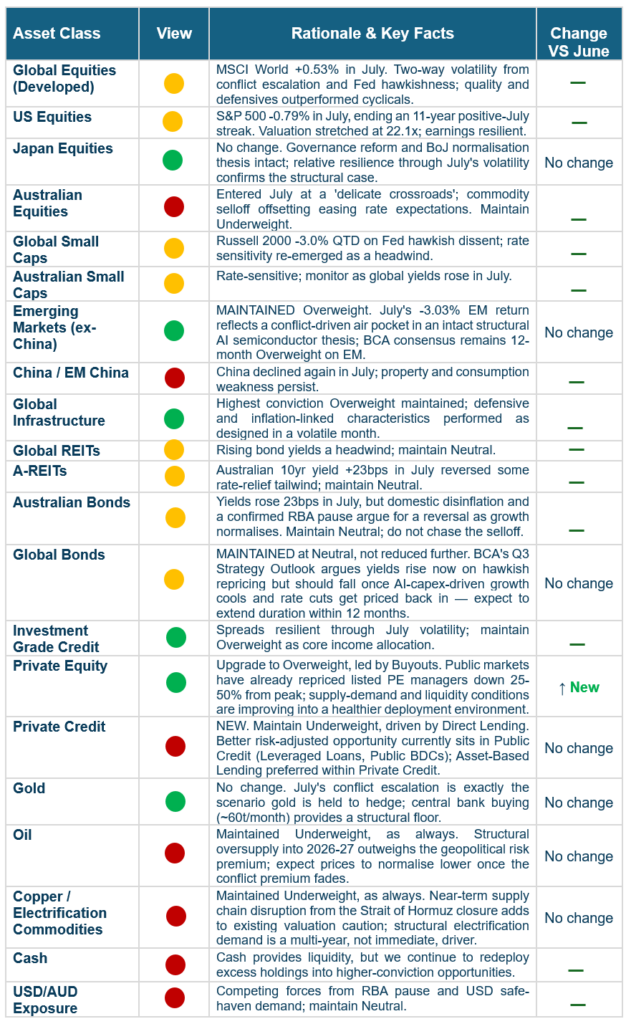
Key: 🟢 Overweight / Positive 🟡 Neutral / Balanced 🔴 Underweight / Cautious ↑ Upgraded ↓ Reduced/Downgraded
APPENDIX: ASSET CLASS PERFORMANCE & REFERENCE DATA – JULY 2026
Key return data and market reference points for July 2026, sourced from official index providers, central bank communications, and major financial data services.
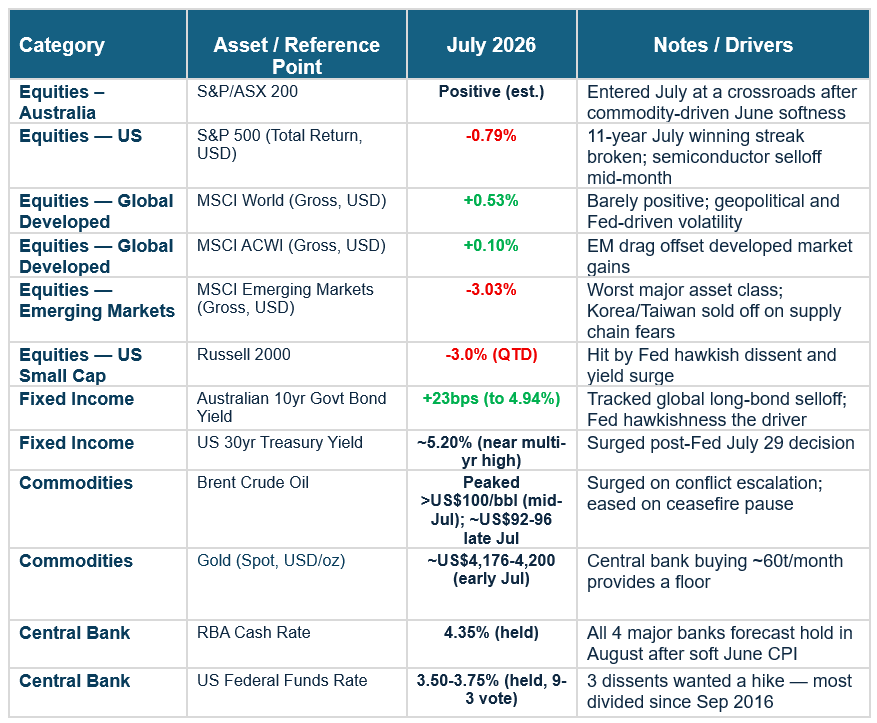
Sources: MSCI Index Factsheet (July 31, 2026); S&P Dow Jones Indices; Amsflow Monthly Return Data; Advisor Perspectives / CNBC (Fed decision, July 29, 2026); YieldReport (July 30, 2026); CommBank Economics; Integrated Finance Group (RBA August preview); BCA Research: Third Quarter 2026 Strategy Outlook: Aging Bull (Peter Berezin, 26 June 2026); China And EM Profitability: A Floor, Not A Launch Pad (Gabriel Gosselin, 7 August 2026) and BCA 12-Month Strategist Views (May 2026); Quarterly TAA: Back From The Dead – Overweight Private Equity (Brian Payne, Juan Correa, 1 July 2026); Private Equity Is Back From The Dead (Felix Vezina-Poirier, 2 July 2026). Important Disclaimer: This report has been prepared by PPAM for the exclusive use of its clients. It is intended for informational and discussion purposes only and does not constitute financial advice. Past performance is not indicative of future results. Clients should consider their individual circumstances and consult with their PPAM adviser before acting on any information contained in this document.
General disclosure
This research has been issued by Pacific Private. Pacific Private is the provider of the general advice and takes responsibility for the provision of this research. This research has been distributed in confidence and may not be reproduced or disclosed to any other person. If you are not the intended recipient of this document, please notify Pacific Private immediately and destroy all copies of this document. By retaining this document, you warrant to Pacific Private that you are either a sophisticated investor within the meaning of section 708(8) of the Corporations Act 2001 (Cth) (“Corporations Act”) or a professional investor within the meaning of section 708(11) of the Corporations Act.
This research contains general advice and does not take account of your objectives, financial situation or needs. Before acting on this general advice, you should consider the appropriateness of the advice having regard to your situation. We recommend you obtain financial, legal and taxation advice before making any financial investment decision.
Nothing in this research shall be construed as a solicitation to buy or sell any security or product, or to engage in or refrain from engaging in any transaction. This research is based on information obtained from sources believed to be reliable, but Pacific Private does not make any representation or warranty that it is accurate, complete or up to date. We accept no obligation to correct or update the information or opinions in it. Opinions expressed are subject to change without notice. Pacific Private accepts no liability whatsoever for any direct, indirect, consequential or other loss arising from any use of this research and/or further communication in relation to this research.
Pacific Private has established and implemented a conflicts policy, which may be revised and updated from time to time, pursuant to regulatory requirements; which sets out how we must seek to identify and manage all material conflicts of interest. Staff involved with the preparation of research have regular interaction with companies they cover. Additionally, Pacific Private does and seeks to do business with companies covered by research.
There are robust information barriers in place to protect the independence of research’s product. However, recipients of research should be aware of this potential conflict of interest.
Pacific Private, its officers and employees may have conflicting roles in the financial products referred to in this research and, as such, may effect transactions which are not consistent with the recommendations (if any) in this research. Pacific Private may receive fees, brokerage or commissions for acting in those capacities and the reader should assume that this is the case. Pacific Private‘s employees or officers may provide oral or written opinions to its clients which are contrary to the opinions expressed in this research.
Persons who do not have professional experience relating to investments should not rely on this document. The distribution of this document in jurisdictions outside Australia may be restricted by law and you should observe any such restrictions. A failure to comply with any such restrictions may constitute a violation of law.