MONTHLY ECONOMIC & INVESTMENT REVIEW:
August 2026 was a month of two distinct phases. For most of the month, global markets extended the risk-on tone of recent months: equities rose broadly, gold recorded its strongest month since January, and emerging markets rebounded sharply from July’s Iran conflict-related weakness. The S&P 500 gained 2.7% to reach fresh record highs, supported by a closely watched measure of US business activity that reached its strongest level in more than four years.
That constructive tone did not last. In the final week of August, the Federal Reserve Chair struck a notably firmer tone on inflation at a closely watched conference, and on 16 September the Federal Reserve followed through: it raised its benchmark interest rate by a quarter of one percentage point, to a range of 3.75-4%, its first increase since 2023. The decision passed unanimously, a marked shift from the divided vote at its previous meeting, and the committee’s own projections point to further tightening both later this year and into 2027. Separately, and more consequential for our own domestic positioning, Australia’s economic growth for the June quarter surprised materially to the upside at the same time as inflation data ran hot. The combined effect was a rapid repricing of expectations for the Reserve Bank of Australia: markets now assign a meaningfully higher probability to a rate rise at the 29 September meeting than seemed plausible only weeks earlier, and the Australian 10-year government bond yield rose to its highest level since 2011.
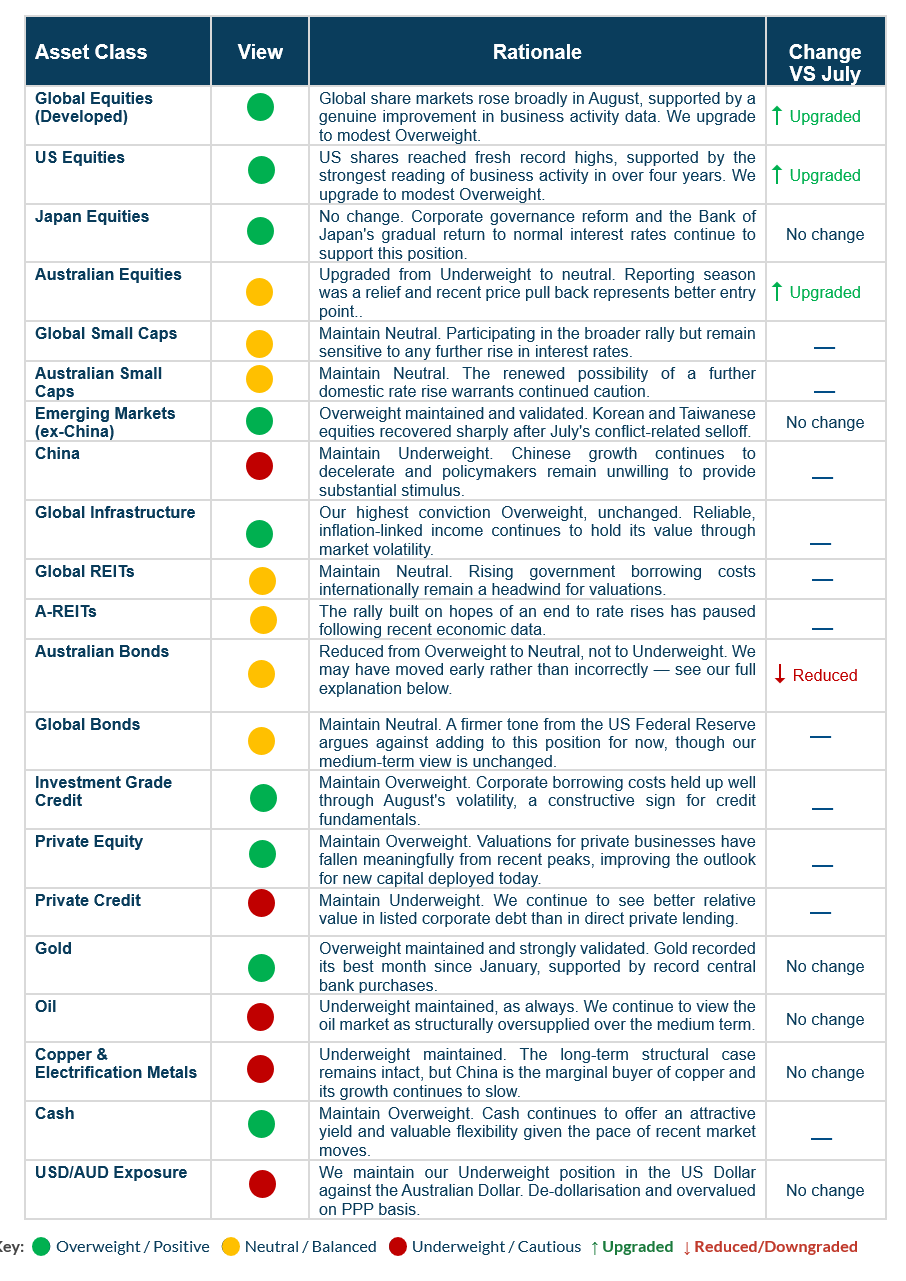
This represents a genuine and important reversal from the position set out in our recent Growth, Inflation and Bond Market outlook, where we argued the domestic tightening cycle had concluded and moved Australian government bonds to a modest Overweight. That view has been tested by recent events, and we address the implications directly below. We reduce our position in Australian government bonds and A-REITs from Overweight to Neutral, while maintaining our medium-term view that yields will eventually decline as growth slows and the current investment boom in artificial intelligence infrastructure cools.
Elsewhere, several existing convictions were reinforced rather than challenged. Our Overweight position in gold, built on sustained central bank purchasing, was strongly validated by August’s 10% rally. Our decision to maintain an Overweight in emerging markets ex-China through July’s volatility was rewarded by a sharp recovery in Korean and Taiwanese equities as AI-linked chipmakers stabilised following July’s conflict-driven scare. We are also upgrading our view on US and global developed equities to a modest Overweight, and moving Australian equities from Underweight to Neutral, reflecting genuinely encouraging activity data across both markets during the month and recent pull back in the overall market.
We continue to maintain our Underweight position in the US Dollar against the Australian Dollar, consistent with our longer-term de-dollarisation thesis.
Taken together, August is a reminder that conviction must be balanced with a genuine willingness to update our positioning when the underlying evidence changes. Read the full paper to better understand where and why our views have shifted.
Investment View Changes — Rationale & Evidence
- Australian Bonds: Overweight → Neutral
We upgraded Australian government bonds to a modest Overweight last month, on the view that the domestic tightening cycle was complete. That view has now been challenged by recent events. Australia’s Q2 GDP surprised meaningfully to the upside, rising 0.4% quarter-on-quarter against an expected 0.3%, and 2.1% over the year against an expected 1.8%. This landed on top of an already firm July inflation reading of 3.6% against a consensus of 3.3%. The combination triggered a rapid repricing: major bank economists moved to forecasting a possible rate rise as early as the 29 September meeting, having previously expected no further moves this year. Markets now assign roughly a 58-66% probability to a rate rise as early as September, with the probability of at least one rate raise by November at almost 100%. The Australian 10-year bond yield rose to 5.17% in response, its highest level since July 2011.
We may have been early and perhaps should have given greater weight to the explicit conditionality in the Reserve Bank’s own August guidance, which judged policy only ‘somewhat restrictive’ and retained a stated bias to raise rates further if required. Instead, we choose to view the RBA’s comments as an attempt to talk the market down. That said, our medium-term view is unchanged: we continue to expect growth to slow and yields to fall as the current investment boom in artificial intelligence infrastructure cools and labour market conditions remain slack. The higher entry yield makes that eventual outcome more attractive, not less. We move our Australian Bond position from Overweight to Neutral, and set an explicit trigger for reassessment: a 29 September decision to hold rates, framed as confirming the tightening cycle is complete, would see us return to Overweight; a rate rise accompanied by a continued restrictive bias would instead warrant a move to Underweight.
2. Global Bonds: Maintaining Neutral, Not Adding
The US Federal Reserve Chair’s address at a closely watched late-August economic conference was firmer than his prior public comments. He described recent inflation data of 3.7%, while characterising current financial conditions as less restrictive than previously suggested. Markets responded by lifting the probability of a near-term rate rise, and long-term US borrowing costs rose to their highest level in almost two decades. This does not overturn our medium-term view that yields should eventually decline as growth slows — but it does mean the timing of that decline has likely been pushed further out. We regard this as the wrong moment to add to our global bond position, and maintain a cautious Neutral stance for now.
During late August, the US Federal Reserve Chair described the recent inflation data of 3.7% as concerning and reaffirmed the central bank’s commitment to its inflation target of 2%. Consequently, the Federal Reserve has now acted on the firmer tone it signalled in late August. We do not read this as reason to move from Neutral to Underweight: our medium-term view remains that growth will eventually slow enough to bring this tightening cycle to an end, and a more restrictive near-term path arguably brings that turning point closer rather than further away. We do treat it as confirmation that the near-term environment for global government bonds remains genuinely unfavourable, and see no case for adding to the position until the committee’s own tightening bias shows signs of softening.
3. Gold, Japan and Emerging Markets: Existing Overweight Views Validated
Three standing convictions were directly reinforced by August’s developments. Gold rose approximately 10% during the month, its strongest performance since January, driven by central bank purchases running at a record pace, up 62% on the prior year. This is precisely the kind of structural, price-insensitive demand that underpins our conviction in this position regardless of near-term volatility; the position held firm even through a brief pullback late in the month following the Federal Reserve Chair’s firmer tone.
Japanese equities rose 3.9% in August, extending a pattern of global investors favouring markets outside a narrowly concentrated US technology trade, and reinforcing our standalone Overweight built on continued corporate governance reform and the gradual normalisation of Bank of Japan policy. Emerging markets ex-China rebounded 3.4%, with Korean and Taiwanese equities recovering close to 7% each as the technology-related concerns that drove July’s selloff eased — direct validation of our decision to maintain the position through that period of volatility rather than reduce into weakness.
4. US & Global Developed Equities: Neutral → Overweight
August’s advance was broad enough across markets, and well supported enough by activity data, to warrant an upgrade from a continued Neutral position. The S&P 500 rose 2.7% to fresh record highs, though the more telling signal was a closely watched measure of US business activity (PMI) reaching its strongest level in more than four years — a genuine, forward-looking indicator rather than a market-sentiment reading. Importantly, this was not a narrowly American move: developed markets outside the US (+2.0%) participated meaningfully rather than lagging, and Japan’s continued strength (+3.9%) formed part of the same broader advance. We are upgrading on the basis of this cross-market participation and the underlying activity data, not on any claim that market leadership within the US itself has broadened — it has not, as the following paragraph makes clear.
We do not dismiss the risks, chief among them that leadership within the US market specifically remains narrow rather than broad. Returns within the technology sector were notably uneven in August, and a broader measure that weights all constituent companies equally underperformed the headline, capitalisation-weighted index for the first time since May — meaning the average constituent lagged well behind the market’s reported gain. We also retain a degree of structural caution regarding the artificial intelligence investment cycle: the cash actually generated by the largest technology companies has continued to compress even as reported earnings rise, and our own base case remains that this cycle cools materially later this year or in 2027. This month’s upgrade reflects a genuine near-term improvement in cross-market participation and activity data, not a change in view on either point — we would revisit this position quickly should activity data weaken, cross-market participation reverse, or capital discipline among the largest technology spenders show signs of the reversal we ultimately expect.
Australian Equities
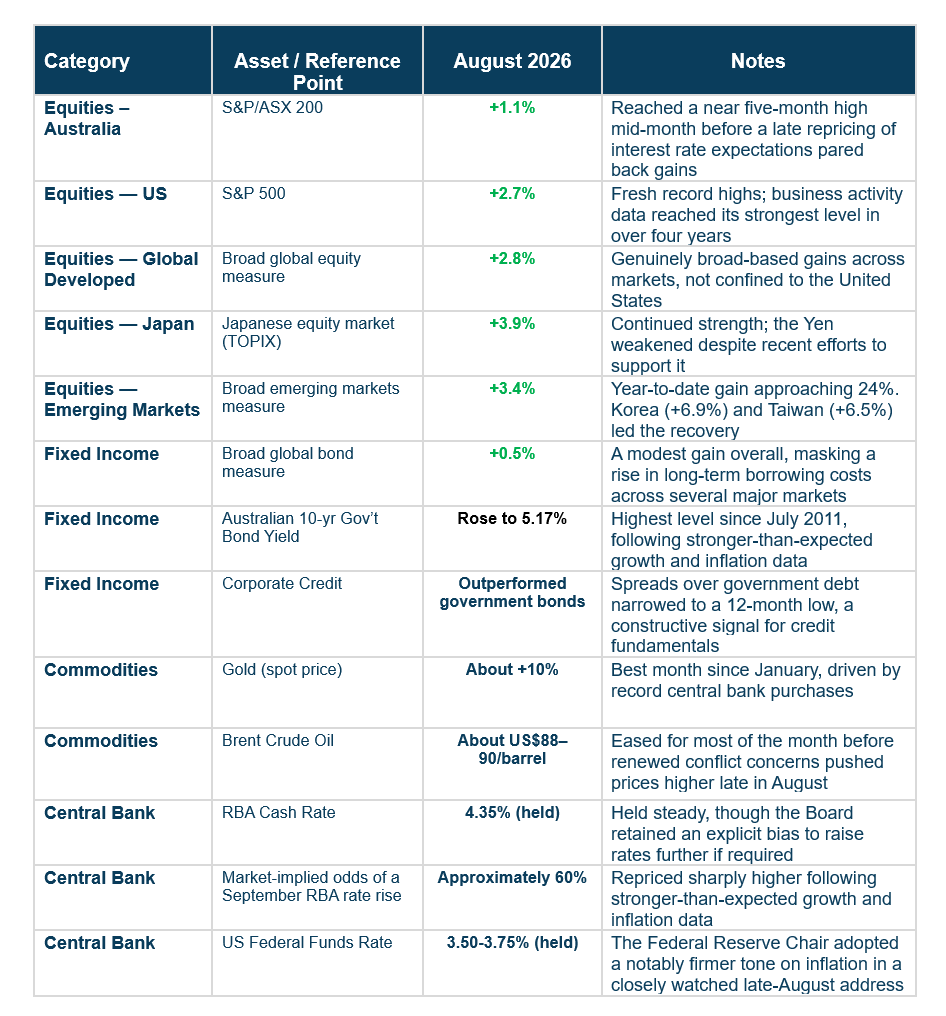
The S&P/ASX 200 rose 1.1% in August, briefly reaching a near five-month high mid-month before a repricing of interest rate expectations in the final week pared back the gains. The pattern was consistent with the broader domestic theme for the year: genuine strength driven by improving corporate earnings and stabilising rate expectations, vulnerable to reversal whenever incoming data reopens the tightening debate.
Sector performance in August favoured resource companies, technology and healthcare names, while the major banks were more mixed, coming under pressure into month-end as rate-rise concerns resurfaced. We move Australian equities from Underweight to Neutral this month. Reporting season delivered better-than-feared results across several sectors. The post August sell-off now provides a more attractive entry point for Australian stocks. We stop short of an Overweight given the reopened uncertainty around the September Reserve Bank decision and its direct implications for bank and property valuations.
Global Developed Equities
Global developed markets were barely positive in July: the MSCI World returned +0.53% and Global developed markets advanced broadly in August, with a genuinely global measure of equity performance rising 2.8% and developed markets outside the US contributing meaningfully rather than lagging. The US market rose 2.7%, supported by the business activity data discussed above. As addressed in our investment view changes, this breadth of participation, together with the strength of the underlying activity data, supports our decision to upgrade both US and global developed equities this month.
Beneath the headline, leadership within the US market remains concentrated. Returns within technology-related names were notably uneven, and the equally weighted measure of the S&P 500 underperformed the capitalisation-weighted index for the first time since May, indicating that the average constituent continues to lag the reported market gain. We regard cross-market breadth as the more important signal for this month’s positioning, while continuing to monitor US market concentration closely.
Emerging Markets
Emerging markets rebounded sharply in August, with a broad measure rising 3.4% and extending the year-to-date gain to approximately 24%. The rebound was led by the same Korean and Taiwanese equities that sold off sharply in July on conflict-related supply chain concerns, with both markets recovering close to 7% as those concerns eased.
Performance elsewhere was more mixed. Indian equities declined modestly on higher energy costs and softer foreign portfolio flows. Smaller Southeast Asian markets were similarly uneven. China remains excluded from our Overweight position; inflation there slowed to a six-month low in July, raising renewed concerns about weak domestic demand, while policymakers remain committed to limited stimulus and household deleveraging continues. We maintain our Underweight on China and continue to watch for a genuine, consumption-focused policy shift as the trigger for reconsidering this position. We maintain our Overweight in emerging markets ex-China; August’s rebound is a clean validation of our decision to hold the position through July’s volatility rather than reduce into weakness.
Real Assets – Property & Infrastructure
Global infrastructure remains our highest conviction Overweight, and nothing in August’s developments changes that view. The structural case — reliable, contracted, inflation-linked cash flows — continues to hold regardless of month-to-month rotation in broader risk sentiment.
Global REITs remain at Neutral. Government bond yields reached fresh cycle highs in several major markets during August, a persistent valuation headwind that has not yet resolved despite the broader equity rally. Australian A-REITs are the clearest domestic sector affected by this month’s repricing: the sector had rallied through the middle of the year on the expectation that the domestic tightening cycle was complete, and the rise in the Australian 10-year yield to its highest level since 2011 has paused that thesis rather than reversed it structurally. We move A-REITs from Overweight to Neutral, in line with our Australian government bonds view, with the same 29 September Reserve Bank decision serving as the explicit trigger for reassessment.
Fixed Income & Interest Rates
August was a month in which two separate developments — one domestic, one from the Federal Reserve — required a genuine reassessment of our fixed income positioning. In Australia, the Reserve Bank held its cash rate at 4.35% on 11 August, unanimously, but retained an explicit bias to raise rates further should upside inflation risks materialise. That conditionality was tested almost immediately by the subsequently released growth and inflation data. Australian 10-year bond yields rose to their highest level since 2011 as a result, though it is worth noting that global forces contributed meaningfully alongside domestic data: government bond yields rose across several major markets during the month, reflecting sustained fiscal deficits, elevated government debt issuance, and broader bets on tighter monetary policy internationally, including from the Bank of Japan.
The compensation (Term Premium) investors demand for holding longer-dated government debt — separate from where they expect the policy rate itself to go — has followed a telling path this year: it compressed through the first half of 2026 before reversing sharply in recent months, in the same window as the broader global bond selloff described above. This is not proof that this factor, rather than growth and inflation expectations, is now the dominant force in the yield curve, but it is a genuine signal that structural pressures — sustained government deficits, heavy debt issuance, and the capital demands of the Ai capex cycle — may be asserting themselves independent of the immediate economic cycle. On 19 August, the US Treasury announced a buyback programme targeting long-term debt, explicitly aimed at containing this pressure; we are sceptical the effect will prove durable, since such buybacks cannot create genuine additional liquidity without a corresponding expansion of the central bank’s own balance sheet. If sustained upward pressure on yields from this source continues, it would argue for holding intermediate rather than long-dated maturities, and for favouring non-US government bonds over US Treasuries specifically — both preferences we already hold.
A further, more acute development in early September reinforces this concern directly rather than abstractly. Ahead of the US midterm elections due on 3 November, a proposal has been floated to issue a once off $5000 payment to every US adult citizen, conditional on the outcome of the vote, at an estimated cost in excess of $1.2 trillion. The proposal remains unfunded, offers no detail on how it would be financed, and faces genuine resistance even from within the party proposing it. Nonetheless, the announcement was followed within days by a sharp rise in government borrowing costs: the 10-year yield rose to its highest level since 2007, the 30-year yield reached its highest level in roughly 24 years. A move of that kind is a meaningful signal: it suggests markets are pricing a genuine risk of expanded government borrowing, not merely a distant and heavily discounted possibility.
We do not regard this as sufficient reason to move to an Underweight position yet. The proposal requires the governing party to first retain control of Congress, an outcome that is genuinely uncertain given current polling, and would then require actual legislative approval, which senior members of the proposing party have already signalled they are unwilling to grant in its current form. A meaningful part of the associated risk premium is also arguably already reflected in current yields, given the speed and scale of the recent move. We do, however, treat this as a live and material risk to our medium-term view, and we are sharpening our positioning in response. We now favour shorter/intermediate maturities over long-dated government bonds more strongly than before, since the long end is bearing the greatest weight of this concern, and we are setting the 3 November midterm election explicitly as a checkpoint for this position. A result that removes the prospect of this proposal advancing would support our existing medium-term case for duration; a result that keeps it alive, followed by genuine legislative momentum, would instead warrant a move to Underweight.
The Federal Reserve’s rate rise adds directly to the upward pressure on government borrowing costs already discussed above, layering a confirmed tightening cycle on top of the fiscal and term-premium concerns already weighing on long-dated yields. This reinforces our preference for intermediate over long-dated maturities and for non-US government bonds over US Treasuries specifically, since the long end continues to bear the combined weight of both pressures.
We maintain Global Bonds at a cautious Neutral and move Australian Bonds from Overweight to Neutral, for the reasons set out in our investment view changes section: we may have moved early, not incorrectly, and our medium-term view on duration is unchanged. We continue to favour Investment Grade Credit at Overweight. The pressure on government bond yields this month is fundamentally a government borrowing story, driven by fiscal deficits and heavy debt issuance, not a reflection of company-level financial stress; company balance sheets, by contrast, remain in genuinely good health, with improving debt serviceability and resilient earnings supporting the case for holding corporate over government debt. That said, we recognise this position carries a real, asymmetric risk: the extra compensation investors receive for holding corporate over government debt has narrowed to a 12-month low, which leaves comparatively little room to absorb a broader deterioration in market conditions should the fiscal concerns discussed above escalate into a genuine risk-off event. We hold the position on the strength of company fundamentals, and would reassess quickly if evidence emerged that the current fiscal pressure was beginning to spill over into corporate borrowing costs more broadly.
Commodities & Currencies
Gold was the standout commodity story of August, rising approximately 10% as central bank purchases continued at a record pace, up 62% on the prior year — precisely the structural demand that underpins our Overweight position regardless of near-term price volatility. The position experienced a partial pullback late in the month following the Federal Reserve Chair’s firmer tone, which we regard as near-term noise rather than a reason to reduce the position.
Oil eased for most of August before renewed tension between the United States and Iran at month-end reintroduced a fresh risk premium. We maintain our Underweight in oil, consistent with our house view throughout the year, treating these periodic spikes as temporary premiums on a market we continue to regard as structurally oversupplied over the medium term. We maintain the same Underweight in copper and electrification-related metals: the long-term structural demand case remains intact, but China is the marginal global buyer of copper, and we expect further Chinese growth deceleration to weigh on near-term demand regardless of the strength of the longer-term tailwind.
We maintain our Underweight position in the US Dollar against the Australian Dollar. Notably, the US Dollar index actually weakened modestly over August despite the Federal Reserve Chair’s firmer interest rate tone. The longer-term influence of the de-dollarisation and the fact that the USD is 16% over-valued on a purchasing power parity (PPP) helps support our thesis.
Private Markets: Private Equity & Private Credit
We maintain our positioning in private markets unchanged this month: Overweight private equity, Underweight private credit.
We maintain our Overweight in private equity this month. The industry is sitting on a large pool of committed but uninvested capital — around $1.1 trillion in the US alone, and closer to $2.4 trillion worldwide — built up over several years in which high borrowing costs and wide gaps between what buyers and sellers thought businesses were worth kept many deals from happening. That capital is now under genuine pressure to be put to work, largely independent of where interest rates sit. A significant portion was raised between 2022 and 2024, and funds of this type typically must invest or sell within about five years, so managers are increasingly motivated to act. At the same time, the investors who provide this capital are placing greater emphasis on actually getting cash back from previous investments, rather than being satisfied with paper valuations — encouraging fund managers to bring more businesses to market for sale. We are already seeing this play out: the total value of private equity deals reached an eight-year high in 2025 and continued climbing through the first half of 2026, even as the overall number of deals fell, suggesting managers are concentrating their capital on fewer, larger, higher-quality opportunities. However, a genuine risk to this view is worth noting: borrowing costs have risen sharply in recent months, which works against deals that rely heavily on debt and typically widens the gap between what buyers will pay and what sellers expect. There is some comfort in a broader industry shift toward funding deals with more investor capital and less debt, and toward creating value by improving how businesses are run rather than relying on cheap borrowing — leaving the asset class somewhat less exposed to rate swings than a decade ago, though not immune. Overall, this points to a genuinely healthier deployment environment than in recent years, tempered by a fair concern about rising financing costs.
Our Underweight in private credit remains anchored in relative value: we continue to see better risk-adjusted opportunity in listed corporate debt markets. Our concerns remain around the large amount of debt issuance for Ai capex and the health of the property market. We maintain our Underweight in private credit this month, and see the case reinforced by fundamentals rather than valuation alone. Private credit funds’ lending to artificial intelligence and data centre projects has surged from near zero to more than $200 billion in outstanding loans within a few years, with a further $800 billion projected over the next two years — a level of sector concentration that leaves the asset class increasingly exposed to a single, fast-moving theme rather than diversified across the broader economy. The underlying loan structures compound this risk: several recent, large data centre financings carry maturities that extend beyond the length of the customer contracts backing them, meaning lenders are in practice underwriting contract renewal and continued demand for compute capacity, not simply lending against secured, already-contracted cash flow. Separately, and adding a second source of pressure, commercial property markets remain under genuine strain, with distress in commercial mortgage-backed securities projected to approach 15% by year-end and a substantial wall of property loan maturities due in 2026 requiring refinancing in a considerably tighter lending environment. While most private credit vehicles have limited direct property loan exposure, a broader deterioration in property markets increases the risk of tighter bank credit lines to private credit funds generally and softer investor confidence across the sector, which would constrain private credit’s own cost and availability of capital. Taken together, these fundamental concerns reinforce, rather than substitute for, our existing relative-value case for preferring listed corporate debt over private lending this month.
Volatility & Market Sentiment
August’s pattern illustrates a dynamic we expect to persist through the remainder of the year: genuine, broad-based optimism can shift rapidly when new information arrives. For most of the month, equities, gold and emerging markets all advanced on continued confidence in the global growth outlook. The final week brought two firmer-than-expected developments in quick succession — the Federal Reserve Chair’s address and Australia’s growth and inflation data — that reintroduced genuine two-way risk into markets that had, for a period, priced an unusually smooth path to policy normalisation across major central banks.
The VIX, a widely followed measure of expected US share market volatility, averaged 15.81 during August and briefly touched a year-to-date low of approximately 14.2 in the middle of the month — a level of calm that sat awkwardly alongside record equity prices, an unresolved conflict in the Middle East, and government bond yields already climbing. We regard this less as evidence that risk had genuinely receded and more as a sign of complacency. One widely cited seasonal pattern is worth noting: in every US midterm election year since 1990, a broad measure of the market has pulled back at least 7% from its mid-August peak through mid-October, and this year that historically volatile window began with volatility at its lowest point of the year and equities at record highs — an unusually complacent starting position by historical standards. That calm proved short-lived: the fiscal developments and bond market repricing discussed elsewhere in this report emerged within days of month-end, a reminder that a quiet market is not the same as a genuinely low-risk one.
We regard this as instructive rather than alarming. It underscores the markets uncertainty on whether inflation is genuinely fading or carries more persistence than currently priced.
Global Macroeconomic Overview
The global picture in August combined resilient growth with inflation readings that, in both the US and Australia, ran hotter than markets had positioned for. In the US, a key measure of underlying inflation held at 3.7% over the year to July, a level the Federal Reserve Chair explicitly characterised as concerning.
In Australia, the same dynamic carried sharper consequences for asset prices. Growth of 2.1% over the year, comfortably above consensus, demonstrated the economy is absorbing prior rate rises with less friction than the Reserve Bank itself may have anticipated when it paused in June. Combined with a firm July inflation print, this created the conditions for markets to price a materially higher probability of further tightening than at any point since the original hiking cycle concluded in May.
In China, headline inflation slowed to a six-month low in July, raising the possibility that deflationary pressure could re-emerge as fiscal policy tightens and household deleveraging continues, even as export growth has remained comparatively resilient. We continue to watch for a genuine, consumption-focused policy shift as the key trigger for reconsidering our China position.
Central Bank Policy
US Federal Reserve: The Federal Reserve Chair delivered a notably firmer address at a closely watched late-August economic conference, marking his hundredth day in the role. He recommitted explicitly to the central bank’s inflation target (2.0%), describing July’s underlying inflation reading of 3.7% as concerning, and characterised current financial conditions as less restrictive than previously suggested — a meaningful shift from his more equivocal comments in July. Markets responded immediately, lifting the probability of a near-term rate rise; several major bank research desks characterised the address as unexpectedly firm. Separately, the US Treasury announced in mid-August a buyback programme for long-term government debt, explicitly aimed at containing upward pressure on long-term borrowing costs — an approach that appears at odds with a central bank chief simultaneously signalling a firmer policy stance.
The Federal Reserve raised its benchmark interest rate by 0.25 percentage points on 16 September, to a target range of 3.75-4%, its first increase since 2023 and a direct follow-through on the firmer tone struck by its Chair in late August. The decision passed unanimously, a marked change from the divided vote at the prior meeting, where three members had already favoured an increase. The committee’s updated projections show most officials expect at least one further increase before year-end, with several anticipating two, and year-end rate expectations now centred between 4.1% and 4.4%. The Chair reiterated that he would be “hard-pressed to describe broad financial conditions as restrictive,” leaving little ambiguity about the committee’s near-term intent.
Reserve Bank of Australia: The Reserve Bank held its cash rate at 4.35% on 11 August in a unanimous decision, following three prior rate rises earlier in the year. The Board judged policy only ‘somewhat restrictive’ and explicitly retained a bias to raise rates further should upside inflation risks materialise — a conditionality tested almost immediately by the subsequent growth and inflation data. The Reserve Bank’s own central forecast, published alongside the August decision, continues to expect inflation to ease gradually over the following two years, though markets now price a materially higher probability of near-term tightening than that guidance would have implied only weeks earlier.
OUTLOOK
Two specific risks warrant explicit mention alongside our own priorities for September, as they are more concrete than the general caution we have expressed regarding the artificial intelligence investment cycle to date. First, fiscal drag in the United States is expected to intensify: government spending was already a net drag on Q2 growth, and under current settings this drag is projected to subtract close to a full percentage point from GDP by the end of 2027. Second, and more specific to the technology investment cycle itself, early signs suggest at least one major technology supplier may be relying more heavily than previously on financing its own customers’ purchases — a pattern that, while not yet a cause for concern given the company’s current financial health, has historically served as an early indicator worth monitoring in prior technology cycles.
We enter September having tempered, rather than reversed, our fixed income positioning. The evidence supporting an Australian tightening cycle we had regarded as complete, shifted materially within the space of a single month, and continuing to add to an Overweight position in the face of that evidence would have represented a failure of discipline. Abandoning the position entirely, however, would risk the opposite error — treating a single month of firm data as though it overturns a medium-term thesis that remains intact. We move to an explicitly data-dependent Neutral position rather than prematurely change our view completely.
Elsewhere, several convictions were reinforced rather than challenged this month. Gold’s structural case, built on sustained central bank demand, remains as robust as ever. Our decision to hold firm on emerging markets through July’s volatility was rewarded by August’s recovery. Japan and global infrastructure both remain steady, high-conviction positions. We have also become more constructive on US and global developed equities and on Australian equities, reflecting genuinely encouraging data during the month, while remaining alert to the risks that persist, particularly around the sustainability of the current technology investment cycle.
The Federal Reserve has now moved from signalling to acting, raising rates on 16 September with a unanimous vote and a clear signal of more to come. The question for the months ahead is no longer whether the Federal Reserve would tighten further, but how far this cycle now extends, and how it interacts with the fiscal risks already discussed in this report. We will monitor both closely and adjust our positioning as the evidence warrants.
CURRENT PORTFOLIO STRATEGY & ASSET ALLOCATION
The following table sets out our current positioning across major asset classes. Changes are shown relative to the July 2026 position.
APPENDIX: ASSET CLASS PERFORMANCE & REFERENCE DATA – AUGUST 2026
Important Disclaimer: This report has been prepared by PPAM for the exclusive use of its clients. It is intended for informational and discussion purposes only and does not constitute financial advice. Past performance is not indicative of future results. Clients should consider their individual circumstances and consult with their PPAM adviser before acting on any information contained in this document.
General disclosure
This research has been issued by Pacific Private. Pacific Private is the provider of the general advice and takes responsibility for the provision of this research. This research has been distributed in confidence and may not be reproduced or disclosed to any other person. If you are not the intended recipient of this document, please notify Pacific Private immediately and destroy all copies of this document. By retaining this document, you warrant to Pacific Private that you are either a sophisticated investor within the meaning of section 708(8) of the Corporations Act 2001 (Cth) (“Corporations Act”) or a professional investor within the meaning of section 708(11) of the Corporations Act.
This research contains general advice and does not take account of your objectives, financial situation or needs. Before acting on this general advice, you should consider the appropriateness of the advice having regard to your situation. We recommend you obtain financial, legal and taxation advice before making any financial investment decision.
Nothing in this research shall be construed as a solicitation to buy or sell any security or product, or to engage in or refrain from engaging in any transaction. This research is based on information obtained from sources believed to be reliable, but Pacific Private does not make any representation or warranty that it is accurate, complete or up to date. We accept no obligation to correct or update the information or opinions in it. Opinions expressed are subject to change without notice. Pacific Private accepts no liability whatsoever for any direct, indirect, consequential or other loss arising from any use of this research and/or further communication in relation to this research.
Pacific Private has established and implemented a conflicts policy, which may be revised and updated from time to time, pursuant to regulatory requirements; which sets out how we must seek to identify and manage all material conflicts of interest. Staff involved with the preparation of research have regular interaction with companies they cover. Additionally, Pacific Private does and seeks to do business with companies covered by research.
There are robust information barriers in place to protect the independence of research’s product. However, recipients of research should be aware of this potential conflict of interest.
Pacific Private, its officers and employees may have conflicting roles in the financial products referred to in this research and, as such, may effect transactions which are not consistent with the recommendations (if any) in this research. Pacific Private may receive fees, brokerage or commissions for acting in those capacities and the reader should assume that this is the case. Pacific Private‘s employees or officers may provide oral or written opinions to its clients which are contrary to the opinions expressed in this research.
Persons who do not have professional experience relating to investments should not rely on this document. The distribution of this document in jurisdictions outside Australia may be restricted by law and you should observe any such restrictions. A failure to comply with any such restrictions may constitute a violation of law.