MONTHLY ECONOMIC & INVESTMENT REVIEW:
September 2026 was the month in which the bond market, rather than the share market, set the agenda. Two of the conditional triggers we set out in last month’s report were tested within the space of a fortnight, and both were resolved against us. On 16 September the US Federal Reserve raised its benchmark rate by a quarter of one percentage point to a range of 3.75–4.00%, its first increase since 2023, and its own projections now point to a further rise before year-end. On 29 September the Reserve Bank of Australia followed, lifting the cash rate to 4.60%, its fourth increase this year and the highest setting since late 2011, while explicitly retaining the option to raise rates again.
Against that backdrop, US government borrowing costs rose sharply. The US 10-year Treasury yield climbed by more than half a percentage point over the month to 5.29%, its highest level since 2007, and the 30-year yield reached 5.64%. The move was not driven by a loss of confidence in long-run inflation control — market-based inflation expectations barely moved — but by a rise in real (inflation-adjusted) yields, a poorly received government debt auction, an expanded US Treasury buyback programme that failed to steady the market, and renewed fiscal concern following a proposal for a one-off US$5,000 payment to every adult citizen should the governing party retain Congress in November. Bonds fell almost everywhere: US Treasuries lost 2.3%, global bonds 1.7% and Australian bonds 0.9%. Rate-sensitive real assets were hit harder still, with both global listed property and global listed infrastructure falling more than 5%.
Share markets told a different story depending on where investors sat. The Australian market fell 2.4% including dividends, while a weaker Australian dollar turned flat-to-lower overseas markets into gains for unhedged Australian investors: global developed shares returned 1.9% and emerging markets 2.4% in Australian dollar terms. In local currency terms, however, leadership was extremely narrow — the S&P 500 was held up almost entirely by technology, while most other sectors and most other markets fell.
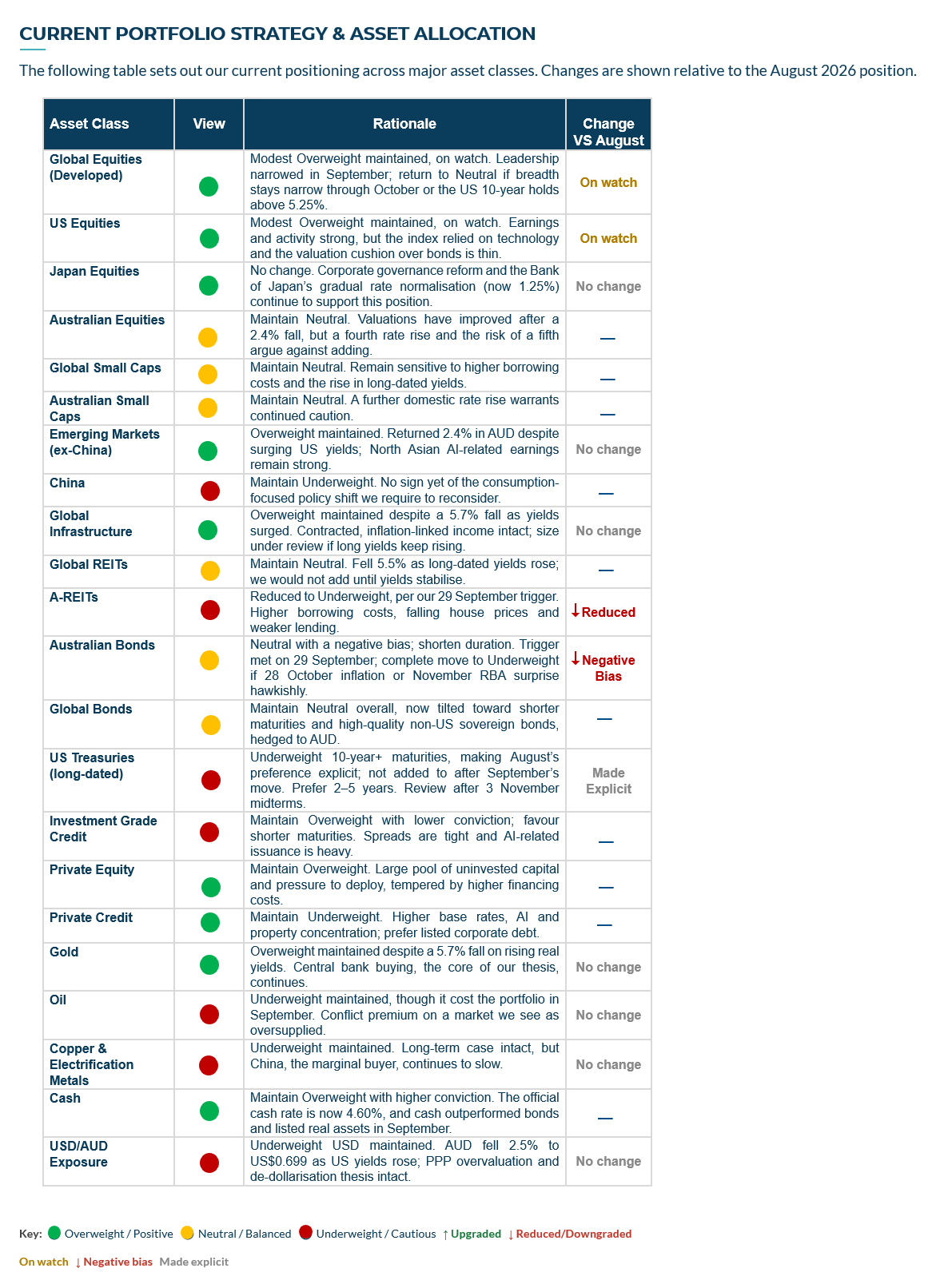
We are honouring the commitments we made, but in measured steps. The Reserve Bank’s decision to tighten with a continued bias to do more met the trigger we set in August for Australian government bonds and A-REITs. We move A-REITs from Neutral to Underweight. For Australian bonds, where the position was Overweight as recently as July and the decisive data are only weeks away, we hold Neutral but adopt an explicit negative bias, with a shorter-maturity tilt, rather than swing to Underweight and risk reversing again in November. On US government bonds, we make explicit the preference we set out in August, showing long-dated US Treasuries as a separate Underweight within an overall Neutral Global Bond allocation. Finally, we maintain our modest Overweight in US and global developed equities, upgraded only last month, but place it on watch: market leadership narrowed sharply in September, and we set out a clear test for October.
Several standing convictions were tested rather than validated this month, and we are candid about it. Global infrastructure, our highest conviction Overweight, fell 5.7% as investors treated it as a bond substitute while long-dated yields surged. Gold fell 5.7% as rising real yields weighed on non-yielding assets, and our oil Underweight cost the portfolio as the Middle East conflict broadened. We explain below why we maintain each of these positions. Cash — now earning 4.60% at the official rate, and one of the few defensive assets to deliver a positive return in September — becomes a more valuable source of both return and flexibility.
Taken together, September is a reminder that explicit triggers are only valuable if we honour them — and that honouring them well means acting in proportion to the evidence rather than swinging positions month to month. Read the full paper to understand where and why our views have shifted, and the checkpoints we are now watching through October and November.
Investment View Changes — Rationale & Evidence
A note on our approach. Our reports set explicit triggers so that clients can see in advance what would change our views. Most of these triggers prompt a review; only some commit us to act. When a trigger is met, our default is to move one step at a time and to use a ‘bias’ or ‘on watch’ marker where the evidence is pointing in one direction but is not yet conclusive. This keeps our positioning responsive without asking clients to trade in and out of positions month to month.
- Australian Bonds: Neutral, With a Negative Bias (Trigger Met)
Last month we moved Australian government bonds from Overweight to Neutral and set an explicit trigger for the 29 September Reserve Bank meeting: a hold framed as the end of the tightening cycle would see us return to Overweight, while a rate rise accompanied by a continued restrictive bias would warrant a move to Underweight. The Reserve Bank raised the cash rate by 0.25 percentage points to 4.60%, unanimously, and stated it would do what it considers necessary to bring inflation back to target, including increasing the cash rate further if needed. That is the second of our two scenarios, and we have acted on it — but in a measured way, for the reasons set out below.
The data released around the decision supports a cautious near-term stance. Headline inflation rose to 4.0% over the year to August, up from 3.5% in July, driven by higher fuel and electricity costs, while the trimmed mean measure of underlying inflation held at 3.6% for a third consecutive month — well above the 2–3% target band. The Board itself noted that the conflict in the Middle East has broadened, that energy prices are much higher than assumed in its August forecasts, and that firms are passing on cost increases. Several major banks now expect a further increase as early as November, which would take the cash rate to 4.85%. The Australian bond market lost 0.9% over the month, and the 10-year yield touched its highest level since mid-2011 before easing to around 5.33% at month-end.
We have chosen not to move all the way to Underweight this month. This position was Overweight as recently as July, and the two pieces of evidence most likely to settle the near-term outlook — the September-quarter inflation release on 28 October and the Reserve Bank’s November meeting — are only weeks away. The same Reserve Bank statement also acknowledged that the economy appears to be slowing, that housing prices have fallen in most capital cities and that new housing loans have declined noticeably; these are precisely the conditions that should eventually bring yields down, and the higher entry yield makes that outcome more attractive. Moving from Overweight to Underweight in two months, only to reverse in November, would serve clients poorly. We therefore hold Neutral with an explicit negative bias: within the allocation we shorten duration, favouring shorter maturities, and we note that cash now offers a highly competitive alternative. A further upside surprise in underlying inflation on 28 October, or a November rate rise, would see us complete the move to Underweight; a clear moderation in underlying inflation and the Reserve Bank dropping its tightening bias would see us remove the negative bias.
- A-REITs: Neutral → Underweight
We tied our A-REIT position to the same 29 September trigger, and we move it to Underweight for the same reason. Listed property is the domestic sector most directly exposed to both the level of interest rates and the outlook for property valuations, and both have moved against it: borrowing costs are higher, and the Reserve Bank has itself highlighted falling housing prices and weaker lending. A-REITs fell 1.9% in September, a smaller decline than the broader market thanks to a sharp rally on the final trading day, but they are down 8.4% over the September quarter and 14% over the past year. That late rally does not alter our assessment, and the 5.5% fall in global listed property over the month illustrates how exposed the sector remains to rising bond yields. We would revisit this position alongside our Australian bond view following the October inflation data and the November Reserve Bank decision.
- US Treasuries (long-dated): August Tilt Made Explicit — Global Bonds held at Neutral
US government bonds remain the most important issue for our fixed income positioning, and we set out our reasoning in full. In August we argued that structural pressures — sustained deficits, heavy debt issuance and the borrowing demands of the artificial intelligence investment cycle — were pushing up the extra return investors demand for holding long-dated government debt, and that this argued for favouring intermediate over long-dated maturities and non-US government bonds over US Treasuries. September provided strong confirmation. The 10-year yield rose roughly 54 basis points over the month to 5.29%, the 30-year yield rose to 5.64%, and the 5-year yield moved above 5% for the first time in nearly two decades. A broad index of US Treasuries lost 2.3% for the month on an Australian dollar hedged basis, compared with a 1.7% loss for global bonds as a whole.
Four developments drove the move. First, the Federal Reserve raised rates and signalled more, with its median projection now pointing to a policy rate of around 4.1% by year-end. Second, US activity data surprised to the upside, with a widely followed business survey showing output growing at its fastest pace in more than five years. Third, and more telling, the market’s capacity to absorb government debt came under visible strain: a US$70 billion 5-year note auction on 23 September met poor demand and triggered the largest one-day rise in the 10-year yield in around 18 months, while the US Treasury’s first expanded buyback operation, targeting up to US$6 billion of 10–20 year debt, purchased less than its maximum and failed to halt the selloff. Fourth, fiscal risk was put back on the table by the US$5,000 payment proposal, estimated to cost more than US$1.2 trillion, coming shortly after total federal debt passed US$40 trillion for the first time.
The most important detail is what did not move. Ten-year breakeven inflation, the market’s own estimate of future inflation, held at around 2.35% through the worst of the selloff. Yields rose because real yields rose, not because investors fear runaway inflation. That is consistent with our term-premium thesis, and it matters for positioning: a rise of this kind is driven by supply, fiscal credibility and competition for capital, and can persist even if the economy cools. Our scepticism about the Treasury buyback programme, which we described last month as unlikely to prove durable, has so far been borne out.
This is not a new trade. Our August positioning already favoured intermediate over long-dated maturities and non-US over US government bonds; we now show long-dated US Treasuries (maturities of 10 years and beyond) as a separate Underweight line so that clients can see that preference clearly. We are conscious that yields have already risen sharply, and we are not adding to this tilt after the move. Nor do we extend it to the asset class as a whole. Real yields are now close to 20-year highs, a genuine source of value, and 2–5 year Treasuries yielding around 4.9–5.1% offer attractive income with considerably less exposure to the long end. Government bonds also retain an important role should the equity market correct in what remains a historically volatile seasonal window. Our overall Global Bond position therefore stays at Neutral, but is now explicitly tilted toward shorter maturities and toward high-quality non-US sovereign bonds, hedged to the Australian dollar, where fiscal risk is either smaller or more fully reflected in prices.
We have three checkpoints for this position. The Federal Reserve meets on 27–28 October; a pause accompanied by softer guidance would ease pressure at the front of the curve. The US midterm elections on 3 November remain the trigger we set last month for the fiscal risk, and it has not yet been tested: an outcome that removes the prospect of the payment proposal advancing would see us remove this tilt, while genuine legislative momentum would see us review whether to extend it to global bonds more broadly. Finally, the US Treasury’s quarterly refunding announcement on 4 November will show whether issuance is being shifted away from the long end. A sustained decline in bond market volatility with yields stabilising would signal that the market has found a new equilibrium, and we would look to add duration at that point rather than before.
- US & Global Developed Equities: Modest Overweight Maintained — On Watch
When we upgraded US and global developed equities in August, we stated that we would revisit the position quickly should activity data weaken, cross-market participation reverse, or capital discipline among the largest technology spenders deteriorate. September gave us cause to revisit it. In local currency terms, markets fell almost everywhere outside a narrow group of US technology companies: the Australian market fell 2.4% including dividends, Japanese equities slipped 1.1%, and emerging markets eased modestly in US dollar terms. Within the US, the S&P 500 finished close to flat only because technology rose around 5%; it was the only sector to gain, while financials, materials and listed property each fell around 7% and the Dow Jones Industrial Average lost more than 4%.
We note that unhedged Australian investors saw a positive outcome — global developed shares returned 1.9% and the S&P 500 2.6% in Australian dollar terms — but that gain came almost entirely from the fall in the Australian dollar rather than from the underlying markets. Having reviewed the position, we maintain our modest Overweight. One month of narrow leadership is thin evidence on which to reverse a call made only a month ago, and the other two conditions we set are intact: activity data remain genuinely strong, corporate earnings continue to surprise positively, and capital spending discipline among the largest technology companies has not deteriorated. We are, however, conscious that with the US 10-year yield above 5.25% the margin of extra return equities offer over risk-free government bonds is unusually thin by historical standards. We therefore place the position on watch. If market breadth remains this narrow through October, or if the US 10-year yield holds above 5.25% through the November checkpoints, we will return to Neutral.
- Global Infrastructure and Gold: Overweights Maintained Despite September’s Setbacks
Global listed infrastructure fell 5.7% in September on an Australian dollar hedged basis, almost exactly matching the 5.5% fall in global listed property. We had expected infrastructure to prove more resilient, and it did not: when long-dated yields rise this quickly, investors tend to treat regulated utilities and long-duration toll and transport assets as bond substitutes and reprice them accordingly. We maintain our Overweight. The underlying case — contracted, often inflation-linked revenues, structural demand from electrification, energy transition and data infrastructure, and an income yield now above 6% — has not changed, and over time inflation linkage allows these businesses to pass higher costs through. We are, however, honest that in the near term infrastructure will not insulate portfolios from a further sharp rise in bond yields, and we would review the size of this position if long-dated yields continue to climb after the November checkpoints.
Gold fell 5.7% in September, giving back much of August’s strong gain, as rising real yields and expectations of further Federal Reserve tightening increased the opportunity cost of holding a non-yielding asset. We maintain our Overweight. The structural driver of our view — sustained central bank purchasing — has not changed: central banks bought close to 289 tonnes in the second quarter, the strongest second quarter on record and 62% higher than a year earlier, and gold remains higher than it was a year ago. We regard September’s fall as a reaction to interest rate expectations rather than a change in the underlying demand case, and we continue to view gold as better portfolio insurance than long-dated government bonds given the fiscal concerns set out above.
Australian Equities
The S&P/ASX 200 Accumulation Index fell 2.4% in September including dividends (the price index fell 3.2%, closing the month at 8,789), after reaching an almost 11-week low mid-month as rising bond yields and growing expectations of a domestic rate rise weighed on the market. A rally over the final three sessions, led by a sharp rebound in property stocks on the last trading day, was too late to recover the month’s losses. The index now sits around 5% below its early-August record high, and Australian shares underperformed global markets by more than four percentage points in Australian dollar terms. Smaller companies fared no better, with the S&P/ASX Small Ordinaries Accumulation Index falling 2.3%, while A-REITs fell 1.9%.
Weakness was concentrated in the major miners and the banks: resource heavyweights fell as commodity sentiment softened outside of energy, while bank shares came under pressure as the probability of a further rate rise increased. We maintain our Neutral position on Australian equities. Valuations are more attractive than at any point since the mid-year, and August’s reporting season was better than feared; however, a fourth rate rise and the prospect of a fifth argue against moving to Overweight until there is greater clarity on the domestic rate outlook.
Global Developed Equities
Global developed markets were broadly flat to modestly lower in local currency terms in September, but the MSCI World ex-Australia Index returned 1.9% for unhedged Australian investors as the Australian dollar fell. In the US, the S&P 500 fell around 0.5% in US dollar price terms (a 2.6% gain in Australian dollars), the technology-heavy Nasdaq rose close to 2%, and the Dow Jones Industrial Average fell more than 4%, snapping a five-month winning streak. Japan’s TOPIX fell 1.1% to 4,109, while the Nikkei 225 managed a modest gain on the back of AI-related stocks, despite posting its first quarterly decline since early 2025.
The breadth of the market was the defining feature of the month. Technology was the only US sector to rise, while sectors most sensitive to interest rates and energy costs fell sharply. This is the narrowing of leadership we warned about in August, and it is why we have placed our modest Overweight in US and global developed equities on watch, with a clear test for October. We maintain our standalone Overweight in Japan, where the Bank of Japan raised its policy rate to 1.25% during the month and corporate governance reform continues to support returns on equity.
Emerging Markets
Emerging markets returned 2.4% in Australian dollar terms in September, having eased by approximately 0.8% in US dollar terms — a resilient outcome given the scale of the rise in US bond yields. The index retains a year-to-date gain of more than 20%. Korean and Taiwanese markets, now the two largest weights in the index, continued to be supported by strong earnings in memory chips and the wider artificial intelligence supply chain.
We maintain our Overweight in emerging markets ex-China. The earnings upgrades driving North Asian markets are genuine rather than sentiment-driven, and valuations remain undemanding relative to developed markets. We remain Underweight China because its economy still relies on investment and exports while household spending stays weak. We would reconsider if Beijing delivered large, funded measures that put money directly into households’ hands, such as income support, a stronger social safety net, or decisive action to stabilise the housing market, rather than further support for industry.
Real Assets – Property & Infrastructure
Listed real assets had a difficult month. Global listed infrastructure fell 5.7% and global listed property 5.5%, both on an Australian dollar hedged basis, as the sharp rise in long-dated bond yields drove a repricing of income-producing assets. This was a disappointing outcome for infrastructure in particular, which we had expected to hold up better than property. As set out above, we maintain our Overweight on the strength of its contracted, inflation-linked revenues and structural growth themes, but we acknowledge that its near-term sensitivity to bond yields is higher than we had allowed for.
Global REITs remain at Neutral, but rising bond yields were a clear headwind, and we would not add to the position until long-dated yields stabilise. As set out above, we move Australian A-REITs to Underweight following the Reserve Bank’s decision, reflecting higher borrowing costs, falling housing prices and weaker new lending.
Fixed Income & Interest Rates
September required a further, and more decisive, reassessment of our fixed income positioning. The key developments — two central bank rate rises within a fortnight and a sharp rise in long-dated US government bond yields — are set out in our investment view changes above. Here we focus on what they mean for the different parts of the bond market. In return terms, US Treasuries lost 2.3% (hedged to the Australian dollar), the global aggregate bond index lost 1.7% (hedged) and the Australian composite bond index lost 0.9%. Government bonds therefore did not provide a cushion in a month when Australian shares also fell — reinforcing the role of cash.
In the US, the selloff spanned most maturities but was most damaging at the long end, where both fiscal concern and supply pressure are concentrated. Notably, the move steepened the yield curve: the gap between 10-year and 2-year yields widened to around 0.4 percentage points, a return to a normal, upward-sloping curve. That steepening is consistent with investors demanding more compensation to lend for longer, rather than with expectations of an imminent recession. The US Treasury’s response — tripling the maximum size of its long-dated buyback operations — did not change the underlying arithmetic of large deficits and heavy issuance, and the market treated it accordingly.
Views from the research houses we monitor are divided, which itself tells us the outlook is genuinely uncertain. Schroders’ September views describe government bond yields as more attractive than at any time in the past decade, but flag inflation risk and fiscal sustainability as key concerns, preferring Japanese and UK government bonds. A major Canadian bank’s fixed income team has reaffirmed a bearish view on the long end of the US Treasury curve, judging the buyback programme to offer only temporary relief and expecting long-end yields to keep setting multi-decade highs. Vanguard’s active fixed income team holds a neutral US duration position while overweighting high-quality credit, citing real yields near 20-year highs. BCA Research’s 2026 outlook recommended only a neutral stance on equities with a bias toward downgrades. Our own positioning — Underweight the long end, Neutral overall, with a preference for shorter maturities and non-US sovereigns — sits deliberately between these views.
In Australia, government bond yields rose by around a quarter of one percentage point across the curve over the month, and the 10-year yield touched its highest level since 2011 before settling around 5.33%. As explained above, we hold Australian government bonds at Neutral with a negative bias and a preference for shorter maturities, with the October inflation release and the November Reserve Bank meeting as the checkpoints for completing or removing that bias.
We maintain our Overweight in Investment Grade Credit, though with less conviction than a month ago and a clear preference for shorter maturities. Company balance sheets remain healthy, and the pressure this month was fundamentally a government borrowing story. However, the extra yield investors receive over government bonds remains tight by historical standards, and corporate borrowing to fund artificial intelligence investment — estimated at around US$400 billion this year — is reshaping the investment grade market and competing with governments for the same pool of capital. We would reduce this position should evidence emerge that government bond market stress is spilling over into corporate borrowing costs.
Commodities & Currencies
Gold fell 5.7% in September to close at US$4,187 an ounce, as discussed above. We maintain our Overweight on the strength of continued central bank demand, and note that major bank forecasts for year-end have converged in a range of roughly US$4,500–5,500.
Oil rose sharply in September as the Middle East conflict broadened. The US and Iran exchanged military strikes in the Strait of Hormuz for the first time since July, and Iran-aligned groups in Yemen attacked energy facilities in Saudi Arabia. Brent crude briefly reached close to US$110 a barrel mid-month before closing the month at US$103.53, a gain of 14.4% for the month on a front-month basis. We are candid that our Underweight position in oil cost the portfolio this month. We nonetheless maintain it. The International Energy Agency has deepened its forecast for a contraction in global oil demand this year to 2.5 million barrels a day, flows through the Strait of Hormuz have recovered substantially, and Saudi Arabia has restored an alternative export route around it. We continue to regard elevated prices as a conflict premium on a market that is oversupplied over the medium term, while accepting that this premium may persist for some time. We maintain our Underweight in copper and electrification metals.
The Australian dollar fell 2.5% over the month to close at US$0.6989, as the rise in US yields and safe-haven demand for the US dollar outweighed the Reserve Bank’s rate rise. The fall boosted the returns of unhedged offshore assets for Australian investors and was the main reason global equities delivered a positive return in Australian dollar terms. We maintain our Underweight position in the US dollar against the Australian dollar. The interest rate differential still favours Australia at the short end, the US dollar remains materially overvalued on a purchasing power parity basis, and the longer-term de-dollarisation thesis remains intact; we regard September’s move as cyclical rather than structural.
Private Markets: Private Equity & Private Credit
We maintain our positioning in private markets unchanged this month: Overweight private equity, Underweight private credit.
The case for private equity remains built on the large pool of committed but uninvested capital — around US$2.4 trillion worldwide — and growing pressure on managers to both deploy that capital and return cash to investors. We acknowledge that September’s rise in borrowing costs is a genuine headwind for deals that rely heavily on debt, and we will monitor whether higher financing costs begin to widen the gap between buyer and seller price expectations again. For now, the industry’s shift toward funding deals with more equity and less debt leaves the asset class less exposed to rate movements than in previous cycles.
Our Underweight in private credit is reinforced by this month’s developments. Higher base rates increase the debt-servicing burden on the borrowers that private credit funds lend to, and the asset class’s growing concentration in lending to artificial intelligence and data centre projects leaves it exposed to a single, fast-moving theme. With property prices falling in most Australian capital cities and commercial property markets still under strain globally, we continue to prefer listed corporate debt, where pricing is transparent and liquidity is available.
Volatility & Market Sentiment
September revealed a striking divergence between the equity and bond markets. The VIX, a widely followed measure of expected US share market volatility, remained subdued, sitting around 15–16 through much of the month and ending near 16. By contrast, a widely followed measure of expected US bond market volatility reached a three-month high in late September as Treasury yields jumped. Put simply, the bond market was pricing genuine stress while the share market was not.
We regard this divergence as a risk rather than a reassurance. Historically, sustained stress in government bond markets has tended to transmit to equities with a lag, through higher discount rates, tighter financial conditions and higher corporate borrowing costs — and September’s falls in listed property and infrastructure show that transmission is already under way in the most rate-sensitive parts of the market. We also note that the seasonal window we highlighted last month — in every US midterm election year since 1990, a broad measure of the market has pulled back at least 7% from its mid-August peak through mid-October — has not yet closed. A calm VIX is not evidence that this risk has passed.
Global Macroeconomic Overview
The global picture in September was one of strong activity combined with inflation that refuses to settle. In the US, headline consumer price inflation held at 3.4% over the year to August, but core inflation rose 0.3% for the month, a little faster than expected, and the gain was concentrated in services outside of housing, the component the Federal Reserve regards as most persistent. Business activity surveys pointed to the fastest output growth in more than five years, and estimates of third-quarter growth ran well above trend. Higher fuel prices flowing from the Middle East conflict are an important part of the inflation story, and the risk is that they feed into broader prices over the coming months.
In Australia, the picture is more finely balanced. Headline inflation rose to 4.0% over the year to August, but the trimmed mean measure of underlying inflation held at 3.6% for a third consecutive month, and several measures suggest the breadth of price increases narrowed. Meanwhile, the Reserve Bank notes that the economy appears to be slowing, consumer spending growth is easing, housing prices are falling in most capital cities and labour market conditions have eased broadly as expected. This is the tension at the heart of our domestic positioning: the near-term inflation data argue for caution on bonds, while the underlying direction of the economy continues to support our medium-term view that yields will eventually fall.
Geopolitical risk remains elevated. The Middle East conflict has broadened rather than resolved, with energy infrastructure now directly targeted, and the Reserve Bank explicitly flagged scenarios in which inflation is higher and activity lower than forecast. We continue to watch for a genuine, consumption-focused policy shift in China as the key trigger for reconsidering our China position.
Central Bank Policy
US Federal Reserve: The Federal Reserve raised the federal funds rate by 0.25 percentage points on 16 September to a range of 3.75–4.00%, its first increase since 2023, in a 12–0 vote. The Committee’s updated projections raised its median expectation for the policy rate at year-end to 4.1%, implying a further increase is likely, and lifted its forecast for core PCE inflation this year to 3.4%. Its brief statement characterised inflation as elevated, economic activity as expanding at a solid pace, and uncertainty as elevated owing in part to geopolitical developments. Markets currently assign a meaningful, though less than even, probability to a further increase at the 27–28 October meeting.
Reserve Bank of Australia: The Reserve Bank raised the cash rate by 0.25 percentage points to 4.60% on 29 September in a unanimous decision, its fourth increase this year following rises in February, March and May. The Board judged that some of the upside risks to inflation flagged in August are materialising, citing higher global energy prices, rapid growth in prices for technology-related goods driven by artificial intelligence demand, and continued pressure on domestic capacity. It retained an explicit willingness to increase the cash rate further if needed. The next key inputs are the September-quarter inflation release on 28 October and the Board’s November meeting.
Bank of Japan: The Bank of Japan raised its policy rate from 1.00% to 1.25% on 18 September, though two dissenting votes and the absence of firmer guidance meant the decision did little to support the yen. Japanese authorities have continued to signal a willingness to intervene in currency markets, following the joint US–Japan intervention at the end of July. The continued, gradual normalisation of Japanese monetary policy remains supportive of our Overweight in Japanese equities.
OUTLOOK
We enter October with a more defensive fixed income stance than a month ago, a modest equity Overweight that we are watching closely, and cash playing a more important role than at any point in this cycle. This is a deliberate response to evidence, not a change in our medium-term views: we continue to expect growth to slow and yields to eventually decline as the current artificial intelligence investment boom matures and tighter financial conditions take effect. What September demonstrated is that the path to that outcome is likely to be longer and more volatile than we had allowed for, particularly at the long end of the US government bond market — and that rising yields can weigh on bonds, listed real assets and domestic equities at the same time.
Our checkpoints for the coming weeks are explicit. The Federal Reserve meets on 27–28 October. Australian September-quarter inflation is released on 28 October, followed by the Reserve Bank’s November meeting. The US midterm elections are held on 3 November, and the US Treasury’s quarterly refunding announcement follows on 4 November. Together, these will tell us whether the tightening cycle in both countries is close to its end, and whether the fiscal risk now embedded in long-dated US yields is likely to grow or recede. We have set out in this report what each outcome would mean for our positioning.
Elsewhere, our core convictions remain in place, though not all were rewarded in September. Japan and emerging markets ex-China held their ground, while global infrastructure and gold were set back by the rise in real yields; we have explained why we retain both and the conditions under which we would revisit them. We remain alert to the risk that stress in the government bond market, which the broader share market has so far largely ignored, transmits more widely into risk assets, and we will continue to adjust our positioning as the evidence warrants.
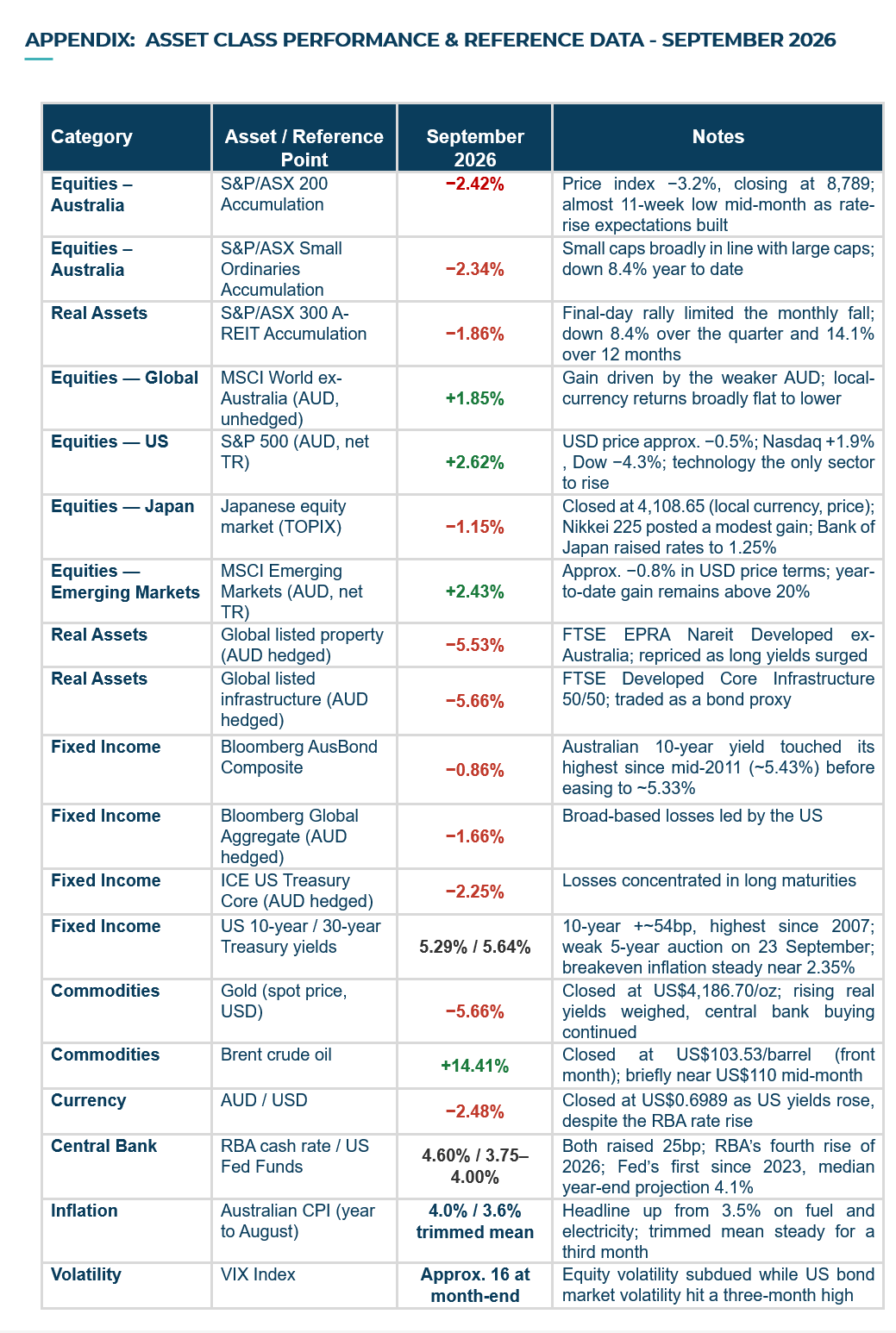
Sources: Reserve Bank of Australia; US Federal Reserve; US Department of the Treasury (daily par yield curve and buyback operations); Australian Bureau of Statistics; US Bureau of Labor Statistics; S&P Dow Jones Indices; MSCI; FTSE Russell; Bloomberg; ICE; BlackRock iShares (published index benchmark returns to 30 September 2026); Japan Exchange Group; International Energy Agency; World Gold Council; Schroders; BCA Research; Vanguard; CNBC. Index returns are total returns in Australian dollars to 30 September 2026 unless otherwise stated; TOPIX, gold, Brent and AUD/USD are month-on-month price changes based on 31 August and 30 September closes; figures marked “Approx.” are price-based estimates in local currency.
Important Disclaimer: This report has been prepared by PPAM for the exclusive use of its clients. It is intended for informational and discussion purposes only and does not constitute financial advice. Past performance is not indicative of future results. Clients should consider their individual circumstances and consult with their PPAM adviser before acting on any information contained in this document.
General disclosure
This research has been issued by Pacific Private. Pacific Private is the provider of the general advice and takes responsibility for the provision of this research. This research has been distributed in confidence and may not be reproduced or disclosed to any other person. If you are not the intended recipient of this document, please notify Pacific Private immediately and destroy all copies of this document. By retaining this document, you warrant to Pacific Private that you are either a sophisticated investor within the meaning of section 708(8) of the Corporations Act 2001 (Cth) (“Corporations Act”) or a professional investor within the meaning of section 708(11) of the Corporations Act.
This research contains general advice and does not take account of your objectives, financial situation or needs. Before acting on this general advice, you should consider the appropriateness of the advice having regard to your situation. We recommend you obtain financial, legal and taxation advice before making any financial investment decision.
Nothing in this research shall be construed as a solicitation to buy or sell any security or product, or to engage in or refrain from engaging in any transaction. This research is based on information obtained from sources believed to be reliable, but Pacific Private does not make any representation or warranty that it is accurate, complete or up to date. We accept no obligation to correct or update the information or opinions in it. Opinions expressed are subject to change without notice. Pacific Private accepts no liability whatsoever for any direct, indirect, consequential or other loss arising from any use of this research and/or further communication in relation to this research.
Pacific Private has established and implemented a conflicts policy, which may be revised and updated from time to time, pursuant to regulatory requirements; which sets out how we must seek to identify and manage all material conflicts of interest. Staff involved with the preparation of research have regular interaction with companies they cover. Additionally, Pacific Private does and seeks to do business with companies covered by research.
There are robust information barriers in place to protect the independence of research’s product. However, recipients of research should be aware of this potential conflict of interest.
Pacific Private, its officers and employees may have conflicting roles in the financial products referred to in this research and, as such, may effect transactions which are not consistent with the recommendations (if any) in this research. Pacific Private may receive fees, brokerage or commissions for acting in those capacities and the reader should assume that this is the case. Pacific Private‘s employees or officers may provide oral or written opinions to its clients which are contrary to the opinions expressed in this research.
Persons who do not have professional experience relating to investments should not rely on this document. The distribution of this document in jurisdictions outside Australia may be restricted by law and you should observe any such restrictions. A failure to comply with any such restrictions may constitute a violation of law.